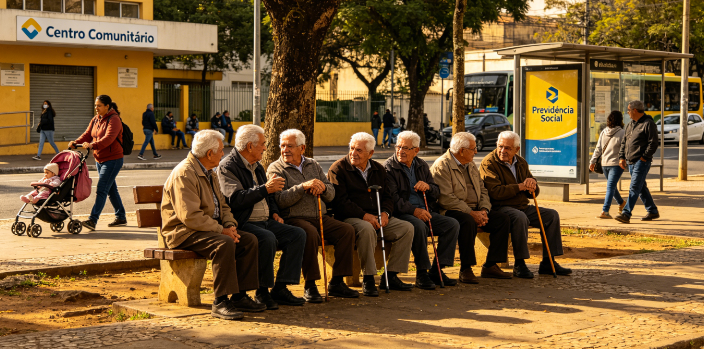
The 2025 Continuous National Household Sample Survey (PNAD) released by the Brazilian Institute of Geography and Statistics (IBGE) shows that Brazil is entering a new phase of accelerating population aging accompanied by slowing growth.
Data indicates that Brazil had a permanent population of approximately212.7 million in 2025, representing a year-on-year increase of just 0.39%. Population growth has remained below 0.60% since 2021. By gender, women account for 51.2% of the population, while men make up 48.8%.
Changes in the population structure are particularly striking. Compared with 2012, the share of people under 40 has dropped significantly by about 6.1 percentage points, while the middle-aged and elderly population has continued to expand: the proportion of people aged 40–49 rose from 13% to 15%, those aged 50–59 from 10% to 11.8%, and people aged 60 and above surged from 11.3% to 16.6%. The population age pyramid shows typical aging characteristics: a narrowing base and an expanding top.
Regionally, demographic differences remain pronounced. The North and Northeast regions have larger young populations, with those under 13 accounting for 22.6% and 19.1% respectively. Meanwhile, the Southeast and South face more severe aging, with 18.1% of residents aged 60 or older in both regions.
Shifts are also occurring in ethnic self-identification. The share of people identifying as white fell from 46.4% in 2012 to 42.6% in 2025, while those identifying as Black rose from 7.4% to 10.4%. The Black population grew most notably in the North, while the South saw a sharp rise in the share of mixed-race (pardo) people and a considerable decline in the white proportion.
Family structure has also evolved. Single-person households increased from 12.2% in 2012 to 19.7% in 2025. Nuclear families still dominate at 65.6%, though their share has declined. There are clear gender differences in living alone: most single men are aged 30–59, while women living alone are most concentrated in the 60-and-older group.
In terms of housing conditions, the share of rented homes rose to 23.8%, an increase of 5.4 percentage points from 2016. The proportion of fully paid-off owner-occupied homes fell to 60.2%. Detached houses remain the main housing type at 82.7%, but apartments now account for 17.1%.
Infrastructure has improved overall, but regional gaps remain stark. Nationwide, 86.1% of households have access to piped water, but the figure drops to only 31.7% in rural areas and a low of 60.9% in the North. For sewage treatment, 71.4% of households are connected to public sewer systems nationwide, compared with just 30.6% in the North — far below the 90.7% rate in the Southeast.
Waste collection coverage rose to 86.9%, yet services remain insufficient in the North and Northeast, where open burning of garbage is common. Electricity access has continued to expand, with only a small number of rural households lacking grid connection nationwide. However, 15.1% of rural households in the North still do not have access to the public power grid.
Meanwhile, ownership of durable goods has steadily increased. In 2025, 98.4% of households owned a refrigerator, 72.1% a washing machine, 49.1% a car, and 26.2% a motorcycle.
Overall, Brazil is undergoing profound transformations in its population structure, household patterns, and living conditions. While aging accelerates and population growth weakens, infrastructure and consumption levels continue to improve. Yet uneven regional development remains a prominent challenge.





China——Brazil Trajectory Tracking



+86 532-85066033/34






 中文简体
中文简体 ENGLISH
