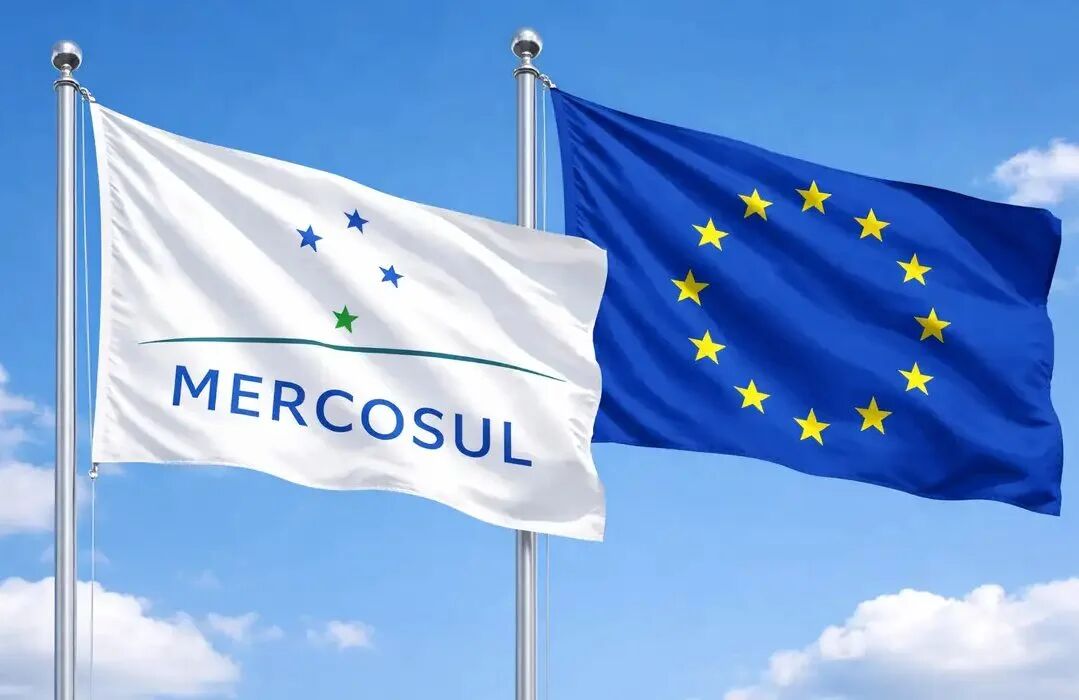
Brazil’s government projects that its exports will rise by approximately 13% upon the full implementation of the Mercosur–EU free trade agreement in 2038. This forecast was announced by Brazilian Vice President Geraldo Alckmin on the eve of the agreement’s partial entry into force. He noted that while tariff cuts will be phased, around 5,000 products will become duty‑free starting May 1 this year, a change set to deliver significant impacts. Alckmin further indicated that industrial exports are expected to surge by up to 26%.
The FTA will partially take effect on May 1 but remains provisional, as several EU member states, including France, have challenged the agreement at the European Court of Justice. Nevertheless, tariff reductions between the EU and Mercosur will commence immediately after May 1, with full liberalization targeted within 12 years.
Alckmin highlighted that sectors such as fruits, sugar, beef, chicken, and certain machinery and equipment will benefit rapidly. He also acknowledged, however, that Brazil’s imports from EU countries are likely to increase accordingly. Currently, bilateral trade between Brazil and the EU stands at roughly $100 billion; the EU is Brazil’s second‑largest trading partner (after China), with a small trade surplus of around $5 billion.
ApexBrasil (the Brazilian Trade and Investment Promotion Agency) estimates that the agreement could add up to approximately $10 billion to Brazil’s trade surplus in its first yearApexBrasil. Studies by the Institute for Applied Economic Research (Ipea) also show that tariff reductions and expanded export quotas could boost Brazil’s GDP by about 0.46% (roughly $9.3 billion) between 2024 and 2040.
Despite the optimistic outlook, the EU’s stringent trade safeguard mechanisms have drawn criticism from Brazil’s agricultural sector. Under the deal, the EU may suspend imports of certain products if volumes exceed 5% of the average over the previous three years. In response, Alckmin argued that the mechanism is “reciprocal”: both Mercosur and EU members can request temporary suspensions in the event of import surges, making the agreement “balanced.”
On the trade negotiation front, Brazil has accelerated its pace in recent years, concluding deals with Singapore and the European Free Trade Association (EFTA). Alckmin also revealed that Brazil is expected to sign new trade agreements with the United Arab Emirates and Canada within the year. Additionally, Mercosur may expand its membership: Bolivia is advancing its accession process, Colombia has expressed interest in joining, and Venezuela—currently suspended—could potentially rejoin in the future.
Meanwhile, Brazil’s government continues to pursue trade talks with the United States. While rulings by the U.S. Supreme Court have lowered most tariffs, sectors including steel, aluminum, and copper still face a global 50% tariff, and automobiles and auto parts are subject to a 25% levy. Furthermore, Brazil is involved in two ongoing U.S. Section 301 investigations: one, covering dozens of countries, focuses primarily on forced labor; the other targets Brazil specifically, addressing issues such as the Pix instant payment system, illegal deforestation, and the digital business environment. These probes could provide grounds for the U.S. to reimpose the 50% tariffs.
Last week, a Brazilian delegation traveled to the U.S. to negotiate the investigations. “We have provided all necessary clarifications and will supplement them if needed,” Alckmin stated, without disclosing detailed talks. He added: “President Lula and President Trump have built a good working relationship, which we hope will endure. There is substantial room for cooperation in both tariff and non‑tariff areas.”




China——Brazil Trajectory Tracking


+86 532-85066033/34






 中文简体
中文简体 ENGLISH
