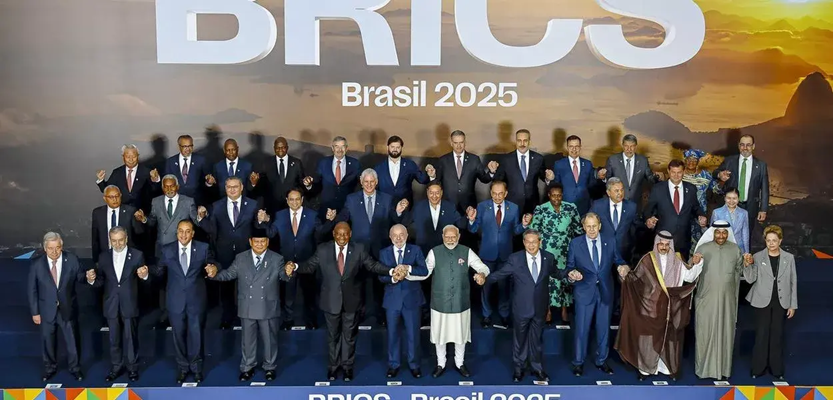
At a recent BRICS meeting, Brazil proposed establishing an independent international payment system named Brics Pay. The initiative aims to reduce reliance on the SWIFT network by enabling direct settlement in local currencies among member states. Under the current global framework, the U.S. dollar generally serves as the intermediate currency for cross‑border transactions, a structure that Brics Pay seeks to reshape.
Modeled after Brazil’s existing instant payment system Pix, the planned platform will facilitate real‑time local currency transfers across BRICS nations and interface with domestic payment networks, thereby boosting the efficiency of cross‑border transactions.
Thiago Godoy, host of Brazilian financial program Resenha do Dinheiro, stated that the core objective is to streamline intra‑BRICS trade procedures. For instance, bilateral transactions between Brazil and China could be settled directly in reais and renminbi, eliminating dollar conversion and SWIFT intermediation.
Nevertheless, the proposal also touches on broader geopolitical shifts and the restructuring of the global financial system. Marilia Fontes, a fixed‑income specialist, argued that developing alternative payment mechanisms helps diversify and stabilize international settlement infrastructure, strengthening trade resilience amid a volatile global landscape.
Meanwhile, market opinions remain divided over the project’s practical feasibility. Bernardo Pascowitch, founder and CEO of Yubb, emphasized that advancing trade integration differs fundamentally from unifying cross‑border payment systems. Citing the European Union as an example, he noted that national approaches to payment coordination vary greatly. Accordingly, designing and implementing a mechanism such as Brics Pay requires full consideration of each member’s institutional framework and economic development stage.







China——Brazil Trajectory Tracking



+86 532-85066033/34






 中文简体
中文简体 ENGLISH
