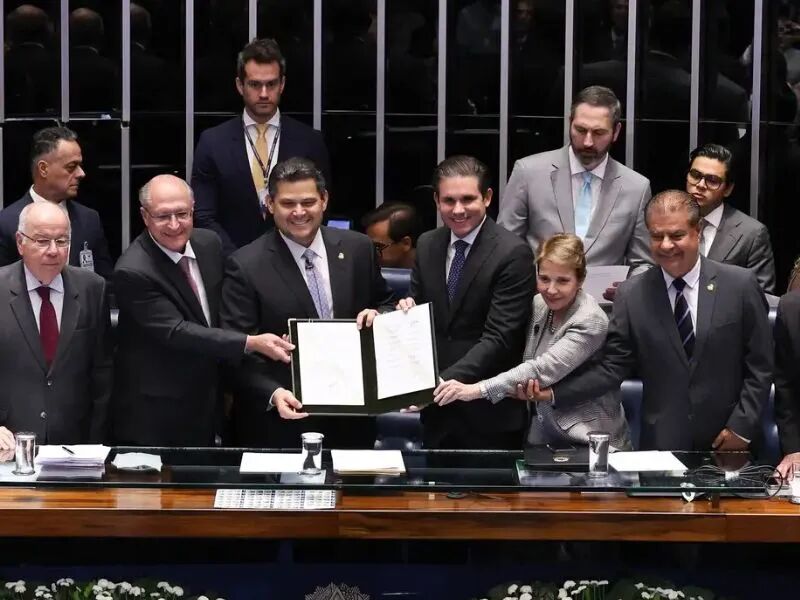
The Brazilian Congress officially approved and enacted the free trade agreement between Mercosur and the European Union on March 17, marking the formation of one of the world's largest free trade zones. While signing and approving the trade agreement decree, the President of the Brazilian Senate and Congress, Davi Alcolumbre, stated that amidst multiple wars and trade tensions globally, the agreement sends a clear signal in support of peace and prosperity.
Addressing parliamentarians and federal government officials, including Vice President and Minister of Development, Industry, and Trade Jerônimo Alckmin, he stated, "Trade is key to world peace. Trade helps build friendly cooperation between nations. Economies that share production chains, investments, and consumer markets rarely engage in armed conflicts that destroy lives and wealth. Trade is a tool for achieving peace and prosperity."
Negotiations for the free trade agreement between Mercosur and the European Union lasted over 26 years, starting officially in 1999. In late January of this year, representatives from both groups signed the terms of the agreement in Asunción, the capital of Paraguay. This agreement will establish a free trade area covering approximately 718 million people with a GDP of around 113 trillion reais.
Less than two months later, the Brazilian Congress completed the voting approval process for the trade agreement earlier this month, marking the final step for the agreement to take effect in Brazil. Meanwhile, the parliaments of other Mercosur member countries—Argentina, Uruguay, and Paraguay—have also completed the voting approval for the trade agreement.
On the EU side, the European Parliament requested a legal assessment of the agreement by the EU Court of Justice in January of this year. However, European Commission President Von der Leyen stated that while the agreement is still under review on the EU side, the EU plans to provisionally implement the trade agreement from May of this year.
The President of the Brazilian Chamber of Deputies, Hugo Mota, emphasized, "In a world filled with protectionism, unilateralism, and uncertainty, this agreement also has political and civilizational value. It brings regions that share fundamental values closer together, including the common defense of democracy, multilateralism, human rights, and sustainable development."
He urged the EU to swiftly finalize the implementation of the trade agreement, stating, "On this side of the Atlantic, I sincerely and confidently hope that the European Parliament and the EU Court of Justice can act promptly at this critical moment and fulfill their duties."




China——Brazil Trajectory Tracking


+86 532-85066033/34






 中文简体
中文简体 ENGLISH
