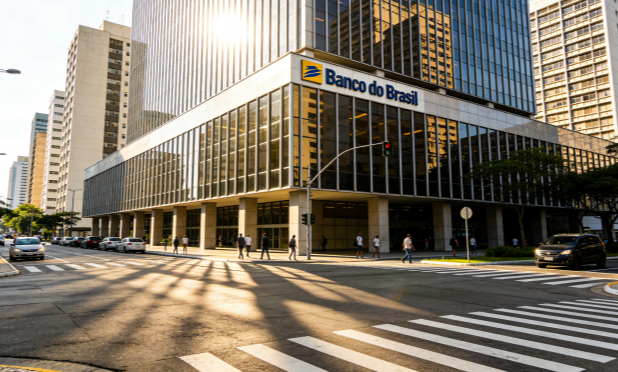
The rapid development of financial technology companies and Pix is putting pressure on the income from banking transaction services, with three of Brazil's four largest listed financial institutions losing nearly 2 billion Brazilian reais due to current account fees. This indicates a structural shift in the industry's business model, aiming to attract customers to purchase credit and investment products through free channels.
As reported by the Brazilian newspaper "O Estado de São Paulo," last year, fees collected by ItaúUnibanco, Bradesco, and Banco do Brasil from bank accounts decreased to 15.155 billion Brazilian reais, an 11% decrease from the same period the previous year. Only Santander saw a slight increase in this income.
Meanwhile, the total revenue from services, including insurance and credit cards, increased by nearly 5% to reach 15.7 billion Brazilian reais. As a result, the proportion of income from current account fees decreased from 15% in 2024 to 13% in 2025.
These figures reflect the efforts made by large banks to adapt to the openness of the financial industry. Financial openness has paved the way for the rise of digital banks, which do not have traditional physical branches and have smaller staff sizes. Financial technology companies attract customers who were previously marginalized by the banking system with a zero-fee model to purchase higher-value services.
By the end of 2025, Nubank, as a major representative of this strategy, surpassed all major traditional banks to become the financial institution with the largest number of users in Brazil, reaching 112 million users, second only to Caixa Econômica Federal.
Under competitive pressure, traditional banks have had to reassess their transaction-based operating models, charging fees for each service provided. Boanerges Ramos Freire, partner and president of the consultancy Boanerges&Cia, explained, "The current strategy is more focused on relationships, where current accounts often serve as free tools to attract customers and encourage them to use higher-value services."
For banks that have grown under a vast network of physical service branches, this transformation poses efficiency challenges. The largest banking groups in Brazil have had to accelerate their investments in technology to enhance the functionality of digital channels while closing thousands of branches. Itaú Unibanco and Santander are building more comprehensive applications to integrate all digital experiences into one platform.
André Mello, partner at Bain & Company, pointed out that the increase in digitization and the decrease in reliance on human services have led to lower customer service costs. He commented, "With the decrease in costs, banks also have the space to reduce fees."
The decrease in fees has also become an incentive measure, encouraging users to consolidate most of their business in one institution, known as the "preferred institution" in the market. According to research from the technology company idwall, approximately 93% of the Brazilian population has a bank account, with an average of over six bank accounts per person.
The challenge lies in persuading customers to repeatedly use services rather than expanding the customer base. Mello emphasized, "This change in behavior becomes a mechanism to attract customers. Banks may even take measures to encourage customer participation by waiving fees."
This strategy is particularly prevalent among low and middle-income groups, which are the primary growth engines for large financial technology companies. Digital accounts help address a long-standing challenge for large banks: how to serve groups with low profitability but significant transaction potential. To achieve this goal, financial institutions have foregone some fee income and instead generated revenue from other areas, such as payroll-deductible loans.
The introduction of Pix has also led to a shift in revenue sources, as it replaces transfer methods that typically incur fees, such as TED (Electronic Immediate Transfer). Nonetheless, the intangible benefits brought by this instant payment system are significant enough to offset income losses. Boanerges pointed out, "Pix has greatly promoted inclusive finance by attracting new users to the system."
Mello added that Pix has also reduced the maintenance and development costs of payment software, as it is based on a more modern and efficient platform. He said, "The income loss from TED is offset by higher customer engagement in other business lines and savings in development costs."
Alexander Toledo, manager and banking industry expert at Peers Consulting+Technology, believes that overall, the banking sector has successfully completed its transformation. He stated that unless there are fluctuations, traditional financial institutions will continue to maintain stable performance and demonstrate a willingness to increase technology investments.
The Brazilian Banking Federation (Febraban) criticized the current bank fee regulation framework in Brazil. The federation pointed out that these rules were established in 2010, earlier than the implementation of Pix and financial openness, hindering service innovation and differentiation. Febraban advocates for updating regulatory provisions to balance service costs without increasing fee amounts or fee income. The organization concluded, "Greater equality in competition will create an environment more conducive to innovation and continuous improvement of user experience, driven by technological progress and customer digital development."







China——Brazil Trajectory Tracking



+86 532-85066033/34






 中文简体
中文简体 ENGLISH
