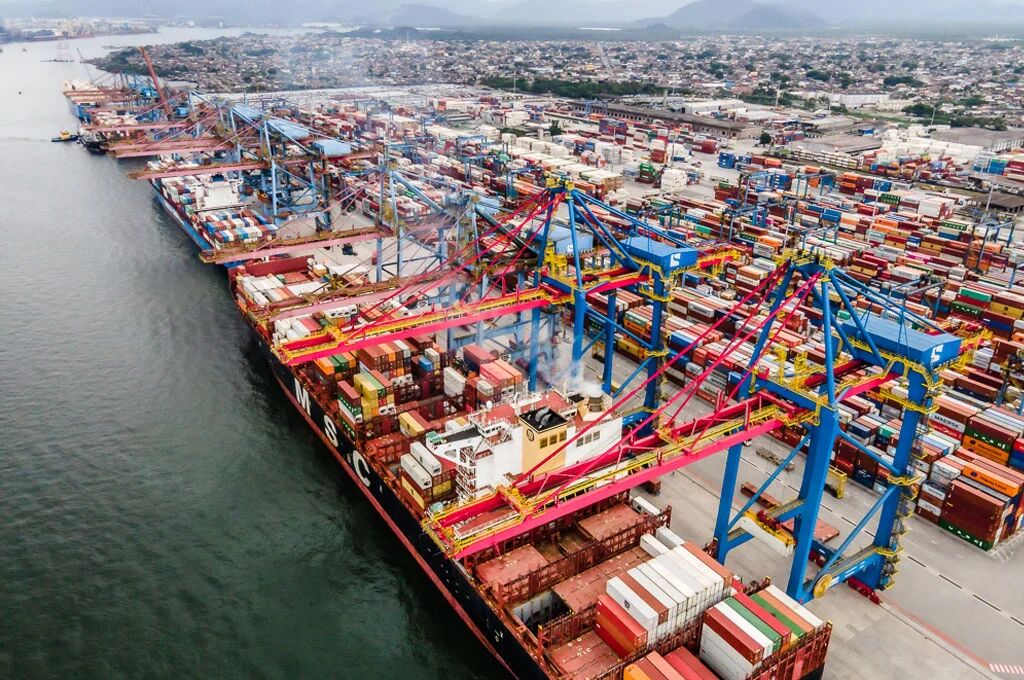
In 2025, the cargo throughput at Brazilian port terminals reached 1.4 billion tons, a 6.1% increase from 1.32 billion tons in 2024. This record throughput data was announced by the National Waterway Transportation Agency of Brazil (Antaq) in Brasília on February 10th.
During the same period, container cargo throughput grew by 7.2% to reach 164.6 million tons. General bulk cargo totaled 658 million tons, marking a 0.8% increase from 2024. Solid bulk cargo throughput grew by 6.3% to 839.7 million tons, while liquid bulk cargo reached 333 million tons (a 6.1% increase).
Overall, iron ore (30%), crude oil (16%), and container cargo (12%) accounted for over 50% of the total cargo throughput. China continues to be the primary destination for Brazilian iron ore exports, importing 72% of Brazil's total iron ore exports during this period.
Frederico Dias, the Director-General of Antaq, stated, "This is a day worth celebrating as the Brazilian maritime industry once again sets a record in cargo throughput." Dias emphasized, "This is not just short-term prosperity but a reflection of sustained growth in the industry, demonstrating the maturity of the country's system and the effectiveness of Antaq's regulatory work." He also highlighted the significant increase in private sector investment in the sector in recent years.
Private sector investment in Brazilian port infrastructure rose from 129.3 billion reais in 2020 to 234.9 billion reais last year. In comparison, public sector investment saw a smaller increase, rising from 36.4 billion reais to 45.1 billion reais, less than half of the 88.7 billion reais during the 2010 period. The total public and private investment increased from 165.7 billion reais to 280 billion reais in just five years.
Dias commented, "Today, Brazil's investment in infrastructure exceeds any historical period, with the private sector nearly doubling its investment, indicating the public sector's ability to collaborate with the private sector." He further noted, "There are limits to productivity and efficiency improvements, so expanding and strengthening Brazil's infrastructure capacity and supply are necessary."
Antaq forecasts a significant growth in container cargo demand at major Brazilian ports over the next four years. The agency's research indicates that port throughput is expected to reach 1.44 billion tons this year, a 2.7% increase from 2025, and is projected to rise to 1.59 billion tons by 2030.
Dias emphasized, "The country must create conditions to meet this significant challenge. Ports cannot be bottlenecks to economic growth. We need to focus on improving access within and around port areas and are currently evaluating which measures need to be taken."




China——Brazil Trajectory Tracking



+86 532-85066033/34






 中文简体
中文简体 ENGLISH
