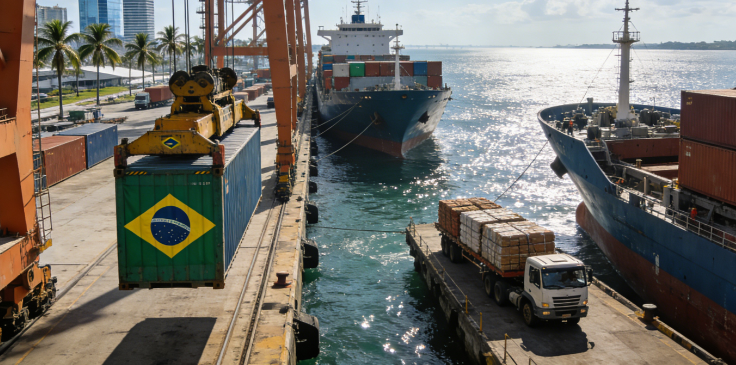
According to a report from the Brazilian Ministry of Development, Industry, Trade and Services, Brazil achieved a record high trade surplus of $68.3 billion in 2025. This included exports of $348.7 billion and imports of $280.4 billion, both reaching historic highs. The report highlights that in 2025, over 40 markets set new records in purchasing Brazilian products, with standout performances from countries such as Canada, India, Turkey, Paraguay, Uruguay, Switzerland, Pakistan, and Norway.
Despite the United States removing a 40% additional tariff on some Brazilian goods, around 22% of exports to the U.S. still face an extra 40% tariff. In response to this tariff pressure, the Brazilian government implemented financial, tax, and market diversification measures to alleviate the short-term impacts of external tariff policies and optimize long-term trade arrangements. Vice President of Brazil and Minister of Development, Industry, Trade and Services, Alckmin, stated that the record-high exports and imports in 2025 indicate the effectiveness of the government's response measures.
To ease operational pressures on businesses, President Lula signed an executive order in August 2025, launching a relief program called the "Sovereign Brazil Plan." This plan includes a special credit program totaling 30 billion reais, primarily aimed at supporting groups heavily impacted such as small and medium-sized enterprises, perishable food exporters, and machinery manufacturers. Additionally, affected companies are allowed to delay federal income tax and value-added tax payments, and the approval time for tax refunds for sales to other markets has been expedited to enhance the efficiency of fund circulation for businesses.
The Brazilian government also introduced a "Priority Purchase of Locally Affected Products" policy, requiring public schools, hospitals, and social welfare institutions to prioritize the selection of locally affected products. Furthermore, Brazil established a National Employment Monitoring Committee to track real-time employment conditions in affected companies and launched industry-specific training programs.
To alleviate tariff pressures by tapping into emerging markets, the Brazilian Ministry of Economy organized trade delegations to visit countries like India and Turkey. Agreements were reached with India on mutual recognition of meat inspections and with Turkey on a memorandum of understanding for machinery equipment trade to enhance the market share of Brazilian agricultural machinery products in Turkey. Data shows that in 2025, Brazil's exports to non-U.S. markets increased from 68% to 72%, with a 6% growth in exports to China.
Brazil submitted a tariff negotiation request to the World Trade Organization, calling for the restoration of the core role of the WTO dispute settlement mechanism. Analysts believe that Brazil's series of measures aim to balance short-term trade stability with long-term structural adjustments, enhancing the ability to respond to external risks through market diversification and industrial upgrading, solidifying its position in the global agricultural and manufacturing sectors.




China——Brazil Trajectory Tracking


+86 532-85066033/34






 中文简体
中文简体 ENGLISH
