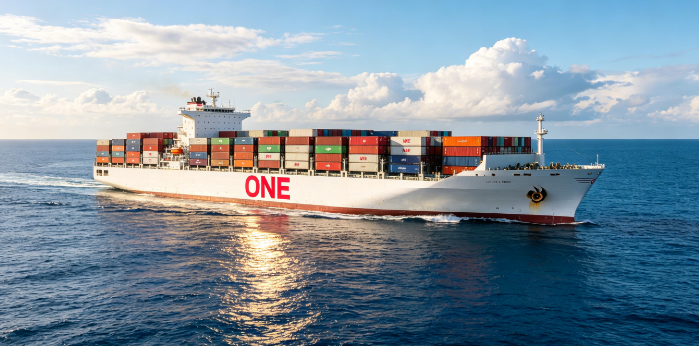
Ocean Network Express (ONE), the major Japanese shipping carrier, has unveiled its financial performance for fiscal year 2025. Hit by weak global container freight rates, rising operating costs, and persistent geopolitical tensions in the Middle East, the carrier saw a sharp contraction in full-year earnings. Nevertheless, amid growing market volatility, ONE remained profitable in the fourth quarter and expects to maintain positive earnings into fiscal 2026.
Financial filings show that in FY2025 (April 1, 2025 – March 31, 2026), ONE recorded operating revenue of USD 16.62 billion, down 13.6% year on year. Net profit tumbled 92% to just USD 338 million, compared with USD 4.24 billion in the previous fiscal year. Over the same period, EBITDA fell 54% year on year to USD 2.75 billion, while EBIT also plunged 92% to USD 310 million. Full-year cargo volume edged up 1% to 12.93 million TEU.
Quarterly performance followed a pattern of strong start, weak finish. The carrier posted a profit of USD 371 million in the first half, before swinging to a loss of USD 88 million in the third quarter (October–December 2025). It returned to profitability in the fourth quarter (January–March 2026), reporting revenue of USD 4.042 billion and net profit of USD 55 million. Though a marked improvement quarter-on-quarter, earnings were still down 82% year on year.
ONE noted that global overall demand remained sluggish in the fourth quarter. However, a seasonal uptick on Asia–Europe routes ahead of the Lunar New Year lifted average vessel load factors on westbound Asia–Europe services to 94%, supporting a temporary recovery in freight rates. The carrier also pointed out that escalating tensions in the Middle East from March pushed up operating costs, though the impact on full-quarter results remained relatively contained.
ONE attributed the steep profit decline to three main factors. First, continuous deliveries of newbuild vessels paired with slowing global demand growth have pressured freight rates on major trade lanes. Second, expenses related to vessel operations, port charges, and empty container repositioning have kept climbing. Third, heightened instability in the Red Sea, Suez Canal and Strait of Hormuz has forced numerous vessels to reroute via the Cape of Good Hope, with longer voyages driving up fuel and operational expenditure.
Looking ahead to fiscal 2026, ONE projects full-year revenue of around USD 18.5 billion, net profit of approximately USD 300 million, EBITDA of USD 3 billion, and EBIT of USD 500 million. The carrier is set to face substantial operational headwinds but is expected to stay in the black.
Meanwhile, ONE is undergoing one of the most significant management reshuffles since its founding. Jeremy Nixon, who has served as CEO since the company’s establishment in 2018, will step down on July 1 and transition to a senior advisory role. His successor, Till Ole Barrelet, joined the company as CEO-designate on May 1 and will formally take office in July.
Jeremy Nixon commented that despite a complex and volatile market environment, strict cost discipline and improved operational efficiency enabled the company to safeguard full-year profitability. He emphasized that crew safety, vessel operational security, and cargo integrity will remain top priorities in the new fiscal year.
On the business front, ONE continues to optimize its global route network. In March 2026, it launched the new Transatlantic AT1 service, deploying its magenta-hulled vessel ONE Satisfaction on the lane for the first time. Delivered in February this year, the 13,900 TEU container ship is methanol and ammonia fuel-ready for future retrofits, reflecting the carrier’s green shipping strategy.
In the same month, ONE adjusted its Spain–Turkey ST2 service and added two new Mediterranean regional routes. Within the Premier Alliance framework, it has also unveiled its 2026 east–west network optimization plan covering core trade lanes including Asia–North America, Asia–Europe, and Asia–Middle East.
The global container shipping market continues to grapple with overcapacity, weak demand, and geopolitical risks. By tightening cost controls and flexibly adjusting its service network, ONE has sustained profitability amid tough market conditions. With new leadership at the helm and further optimization of its global footprint, market attention will focus on whether ONE can stabilize earnings and unlock new growth opportunities in fiscal 2026.





China——Brazil Trajectory Tracking



+86 532-85066033/34






 中文简体
中文简体 ENGLISH
