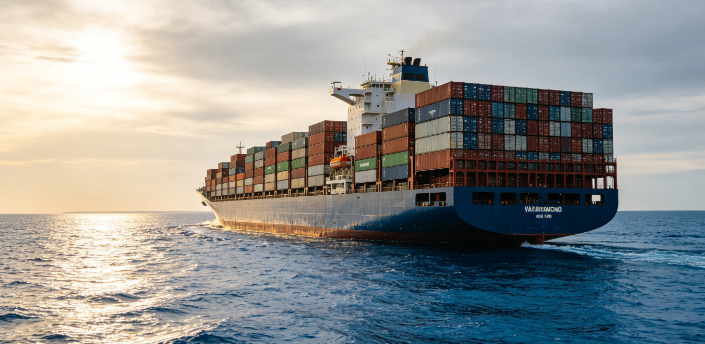
According to data from industry tracking platform Sea Explorer, as of April 28, 2026, the world’s top five container liner companies have deployed a total of 34 vessels in the Persian Gulf region. While this accounts for only a portion of the 103 restricted ships in the area, their combined capacity exceeds 306,000 TEU, representing nearly 88% of the total trapped capacity of around 345,000 TEU. The figures reflect a high concentration of capacity held by leading carriers in the region.
Sources reveal that two major liner companies recently attempted to withdraw their vessels from the area, but the move was suspended after two ships operated by Mediterranean Shipping Company (MSC) were detained. The setback has triggered further delays for multiple routes originally scheduled to pass through the Strait of Hormuz. Meanwhile, Hapag-Lloyd has begun drawing up alternative transportation plans to ease operational pressure.
Rolf Habben Jansen, CEO of Hapag-Lloyd, stated that following limited progress, the carrier is waiting for a viable window to transit the strait. So far, only one vessel, the Tema Express (4,253 TEU), has been successfully evacuated. Vessel tracking data shows that after its AIS signal remained offline for a full month east of the strait, the ship resumed signal transmission on April 21 and is now berthed at Port Sohar.
Breakdowns by carrier show that among the 103 constrained container ships, CMA CGM has the highest number affected at 11 vessels, followed by MSC with 10, Maersk with 6, Hapag-Lloyd with 4, and COSCO SHIPPING Lines with 3. The trapped fleet includes two 15,254 TEU-class vessels owned by CMA CGM and one 10,114 TEU-class vessel from MSC, indicating that large container ships are also deeply caught up in the ongoing crisis.
Faced with persistent uncertainty, multiple carriers have rolled out contingency measures. Industry insiders warn that if the situation cannot be eased in the short term, the shipping sector may face ripple effects, including capacity allocation imbalances and widespread route restructuring. Citing analysts, an American business daily noted that prolonged energy supply tightening could impact global manufacturing and further suppress container shipping demand.
Rolf Habben Jansen disclosed that the company has finalized alternative logistics arrangements, with clear delivery solutions now in place for approximately 92% of stranded cargo. Measures will include blank sailings, voyage cancellations, and route adjustments. Separately, some analysts believe the crisis may drive increased investment in ports and inland infrastructure across the Middle East, fostering alternative logistics corridors to bypass key bottlenecks.
At the global market level, however, the impact remains largely regional. Drewry commented that current market volatility is not comparable to the extreme freight surges seen during the pandemic. Philip Damas, head of its logistics division, pointed out that apart from Persian Gulf-linked trade lanes, overall global container capacity has not contracted notably. Overall, while regional disruptions are severe, the global shipping market has yet to see systemic imbalance.




China——Brazil Trajectory Tracking



+86 532-85066033/34






 中文简体
中文简体 ENGLISH
