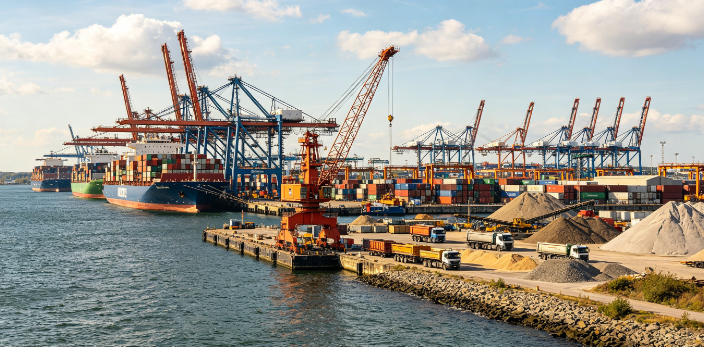
Stretching into the morning glow, the shoreline of Qingdao Port resounds with the rhythmic movement of container gantry cranes and the horns of cargo vessels—forming the most familiar backdrop of this port city. As one of the largest comprehensive ports in northern China, Qingdao Port consistently ranks among the world’s top ports in annual throughput. Underpinning its massive trade volume is a professional and pragmatic community of freight forwarders. Dominated by small and medium-sized enterprises, this group undertakes full-process coordination covering booking, customs declaration, trucking, warehousing, cargo lashing, and loading supervision, serving as an indispensable link connecting shipping lines and import and export enterprises.
Qingdao’s freight forwarding industry emerged in the 1990s, gradually expanding alongside foreign trade system reforms and the upgrading of port infrastructure. Unlike southern ports such as Shanghai and Shenzhen, Qingdao forwarders focus more on routes to Japan, South Korea, Southeast Asia and other near-sea lanes. Leveraging its sea-rail intermodal network, their service reach extends deep into the hinterland along the Yellow River Basin. Export cargo from inland cities including Zhengzhou, Xi’an, Urumqi and across Central Asia flows overseas via Qingdao Port. It is freight forwarders—well-versed in port operations and intermodal connectivity—that coordinate this cross-regional logistics chain.
In recent years, the industry has undergone profound changes. Volatile ocean freight rates, restructuring of shipping alliances, and rising client demand for supply chain visibility are redefining the value of freight forwarders. In the past, competitiveness relied on information asymmetry: whoever secured faster schedules, lower rates and flexible container space could win clients. Today, with transparent pricing and widespread digital platforms, cost advantage alone can no longer sustain market moats. Instead, delivery reliability and exception handling capability have become the core strengths. Amid tight capacity and frequent voyage cancellations triggered by the Red Sea crisis, forwarders that can pre-secure shipping space, design alternative routes, and respond swiftly to emergencies gain a decisive competitive edge.
Digital transformation is also reshaping operational models across the industry. Electronic booking, online customs clearance, and real-time container tracking have become mainstream tools. Leading firms have even built internal data platforms to analyze carrier on-time performance and port congestion cycles, delivering forward-looking logistics recommendations to clients. Yet technology has not diminished human value. On the contrary, while systems handle 90% of routine workflows, the remaining 10% of exceptional cases demand human judgment and resource coordination. Seasoned forwarders can navigate terminal congestion through close communication with shipping agents, truck fleets and warehouses to expedite cargo delivery—an expertise algorithms cannot easily replicate in the short term.
The industry is also undergoing clear professional segmentation. Some firms specialize in cold chain logistics, supporting the booming import of fruits and meat around Qingdao. Others focus on heavy-lift project logistics, offering door-to-site transport solutions for wind power equipment and industrial production lines. Many more cater to cross-border e-commerce, providing parcel line services for small and medium sellers via routes linking Qingdao with Japan, South Korea, Europe and the United States. This specialization transforms forwarders from general intermediaries into value-adding supply chain partners in niche sectors.
Nevertheless, challenges persist. Many small and medium-sized forwarders struggle with talent attrition, slim profit margins and homogeneous competition. Young practitioners, in particular, often find it difficult to stay in the industry amid tedious document work and high-pressure client services. Enhancing industry appeal and establishing a fair profit-sharing mechanism have become critical tasks for sustainable development.
Overall, Qingdao’s freight forwarding industry stands at a crossroads of transformation. Enterprises that move beyond traditional price-differencing tactics and build competitiveness around supply chain integration will stand out amid industry consolidation. For Qingdao as a port city, a healthy, professional and resilient freight forwarding ecosystem serves as indispensable soft power in building itself into an international shipping center in Northeast Asia.




China——Brazil Trajectory Tracking



+86 532-85066033/34






 中文简体
中文简体 ENGLISH
