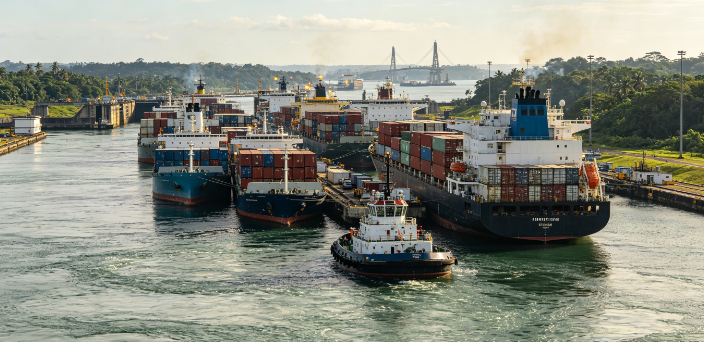
According to Taiwan media reports, as hostilities in Iran disrupt shipping in the Strait of Hormuz, Asian countries have shifted sharply toward U.S. energy purchases, driving a sharp surge in vessel traffic through the Panama Canal. Meanwhile, bidding prices for the canal’s daily transit slots have skyrocketed, with some charterers willing to pay up to 4 million U.S. dollars for priority passage to skip the queue.
Citing reports from the Financial Times and other outlets, shipping disruptions in the Strait of Hormuz have prompted Asian refineries to divert crude procurement away from Persian Gulf suppliers and toward the United States. This shift has substantially boosted transit volumes at the Panama Canal. The Panama Canal Authority (ACP) stated on April 21 that despite evolving global shipping conditions, the canal’s daily vessel throughput remains robust. March traffic rose month-on-month from January levels, exceeding 40 transits per day during peak periods.
Maritime analytics firm Kpler noted that surging shipments of U.S. crude oil and refined fuels via the waterway have pushed average tanker waiting times to 4.25 days, hitting a six‑week high.
Most large vessels secure transit booking windows well in advance and do not participate in the daily spot bidding process, locking in rates generally below the market average. However, amid prolonged queue delays, an increasing number of operators are opting for costly premium slots to avoid lengthy anchorage waits at the canal entrances.
The Panama Canal Authority disclosed that one liquefied natural gas carrier paid a record 4 million U.S. dollars for expedited passage in April, while two additional tankers each secured priority transits at bids of 3 million U.S. dollars in recent weeks.
By comparison, the average daily spot bidding price stood at approximately 130,000 U.S. dollars between last October and this February. This figure has jumped to 385,000 U.S. dollars throughout March and April.
Commodity intelligence provider Argus Media highlighted that daily canal bidding rates have climbed five times higher than pre‑conflict levels. For vessels transiting the Panamax locks, premiums have surged nearly tenfold since the escalation of tensions between the United States and Iran. The ACP emphasized that the dramatic price growth stems from heightened market demand, rather than official adjustments to standard toll tariffs.
As a critical artery for global maritime trade, the Panama Canal handles 5% of worldwide seaborne cargo flows. Serving key trade partners including the United States and China, it connects the U.S. East Coast with major Asian markets such as China, South Korea and Japan.




China——Brazil Trajectory Tracking


+86 532-85066033/34






 中文简体
中文简体 ENGLISH
