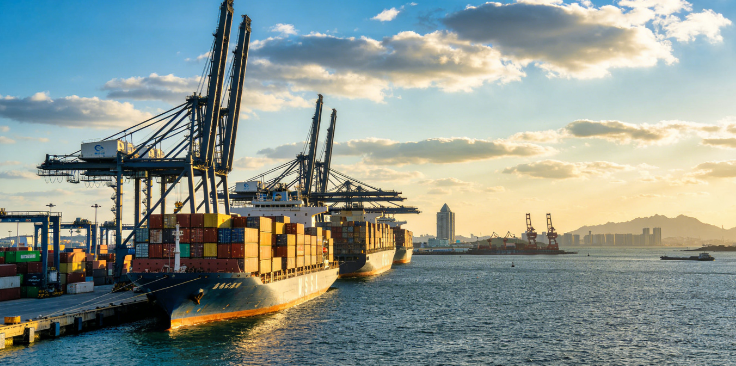
Qingdao, as one of the most important northern Chinese ports for foreign trade, has a mature and professional cargo logistics system that profoundly impacts the efficiency of the supply chain in the Bohai Economic Rim and even the Yellow River Basin. Leveraging world-class port infrastructure, a continuously evolving multimodal transport network, and a highly active professional service market, Qingdao has developed a cargo ecosystem that combines economies of scale with flexible responsiveness. Within this system, Qingdao freight forwarding companies, deeply rooted in the local market with a global perspective, play a crucial role in connecting port functions with industrial demands through their resource integration and solution design capabilities.
Qingdao Port serves as the core engine of the Qingdao freight system. The Qianwan Port Area and Dongjiakou Port Area operate in synergy, forming specialized terminal clusters for containers, ore, crude oil, grains, and roll-on/roll-off vehicles, maintaining a leading position in global annual throughput. The port's competitive advantage is not only reflected in berth depth and cargo handling efficiency but also in its deep integration with the hinterland economy. Regular maritime-rail intermodal trains extend Qingdao Port's outbound functions to Zhengzhou, Xi'an, Urumqi, and even Central Asia, allowing inland enterprises to benefit from the port's route resources and customs facilitation. This logistical pattern of "ports in the field" offers freight service companies extensive operational space and places higher demands on their cross-regional coordination capabilities.
Between port functions and industrial demands, freight service companies play a role in transformation and value addition. Traditional booking and customs clearance services are no longer sufficient to meet the complex needs of modern manufacturing and trading enterprises. Leading companies in the Qingdao freight market are accelerating their transformation into supply chain integrators. Instead of passively receiving transport instructions, they are proactively involved in their clients' procurement plans, inventory deployment, and distribution rhythms. In this process, the role of Qingdao freight forwarding companies has undergone a profound change: evolving from transport intermediaries to process designers and from single-point executors to end-to-end coordinators. Their value is no longer defined by freight differentials but by the systemic optimization of total supply chain costs.
This capability upgrade relies heavily on the deep application of digital tools. The digitalization process in the Qingdao freight industry has evolved from early electronic documentation to full-process visualization and intelligent decision-making stages. Leading Qingdao freight forwarding companies have significantly improved service transparency and response speed through real-time space querying, on-route tracking, and exception alerting features, provided by self-built platforms or access to public logistics data platforms. More importantly, some companies have begun to utilize historical data to train predictive models for quantified analysis of route delay probabilities, port congestion cycles, and freight rate trends, embedding insights into their clients' production planning systems. This transition from "recording logistics" to "computing logistics" is reshaping the value boundaries of Qingdao freight services.
Differentiated professional service capabilities are also reflected in deepening expertise in specific types of goods or markets. Qingdao's export cargo structure is diverse, encompassing traditional strengths such as machinery and equipment, tires, and household appliances, as well as emerging categories like new energy vehicles, lithium batteries, and photovoltaic components. Different types of cargo have varying demands for transportation conditions, documentation requirements, and delivery timeliness. Some Qingdao freight forwarding companies choose to focus on niche segments and establish specialized assets and knowledge barriers in fields like cold chain logistics, hazardous materials transportation, and heavy cargo project logistics. This vertical integration strategy enables them to provide irreplaceable professional services to specific customer groups and establish pricing power in segmented markets.
At the same time, the Qingdao freight ecosystem faces structural challenges. Periodic fluctuations in the shipping market, intensified competition among regional ports, and the gradual implementation of international carbon tariffs are all bringing uncertainty to industry development. For Qingdao freight forwarding companies, a growth model solely dependent on scale expansion is no longer sustainable, and they must iterate towards knowledge-intensive and technology-enabled directions. The urgency for upgrading talent structures is particularly notable—individuals who are well-versed in international logistics rules, proficient in data analysis tools, understand industry operational logic, and possess cross-cultural communication skills are becoming scarce resources in the industry.
In conclusion, the Qingdao freight system is in a transitional phase from "expansion of scale" to "advancement of quality." The continuous improvement in port capabilities provides a solid foundation for industry development, while the evolution speed of professional service providers determines Qingdao's position in the global supply chain division of labor. When freight services are no longer just about moving goods but are integrated into a client's business competitiveness, the expectations and responsibilities that the Qingdao freight forwarding industry carries far exceed traditional definitions.




China——Brazil Trajectory Tracking



+86 532-85066033/34






 中文简体
中文简体 ENGLISH
