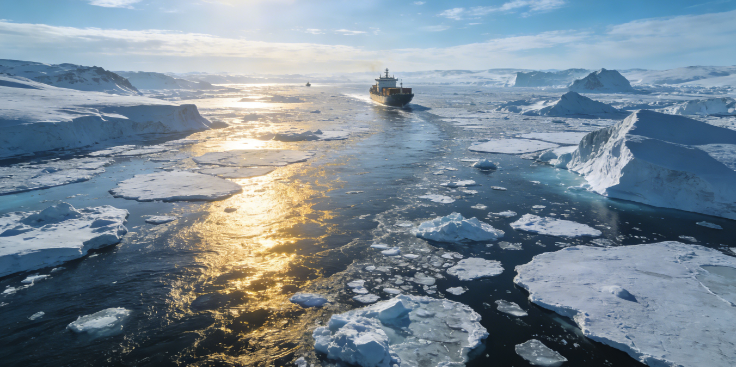
In recent years, maritime trade via the Arctic route has been heating up, becoming an important backdrop to the recent "Greenland Island incident." The Intermodal shipping brokerage company indicated in its latest weekly report that as the commercial value of Arctic shipping routes becomes increasingly prominent, geopolitical competition in the region is significantly intensifying.
According to the Intermodal report, U.S. President Trump has placed the Arctic issue back on the international agenda, publicly stating that Greenland is "vital to U.S. national security" and expressing intentions to incorporate the island into the U.S. sovereignty system. He also warned that if negotiations are stalled, the situation could escalate, with the possibility of military action not being ruled out. This stance has raised concerns in the market about the increasing geopolitical risks in the North Atlantic region and the stability of the alliance system.
Despite the core reasoning provided officially being "national security," industry experts widely believe that what attracts the U.S. is the strategic resource potential that Greenland holds, including oil, natural gas, rare earth minerals, uranium, and various key minerals. However, due to weak infrastructure, extreme climate conditions, and strict environmental regulations, large-scale development of these resources remains a medium- to long-term issue. In the short term, if Greenland falls under U.S. control, it will significantly strengthen its strategic and commercial presence in the Arctic region, which has rapidly evolved into a "new variable" in the global shipping system in recent years.
Quoting research data from the Norwegian High North Logistics Center, Nikos Tagoulis, a senior analyst at Intermodal, stated that despite being small in scale and restricted by navigation times, Arctic maritime trade has maintained a steady growth trend in recent years, with its strategic importance continuing to rise. The Northern Sea Route plays a crucial role in the Russia-China trade system.
The data shows that in 2025, the number of voyages transiting through the Northern Sea Route reached 107, higher than the 97 voyages in 2024, with a 3.2% year-on-year increase in total tonnage, reaching 6.2 million deadweight tons. Compared to ten years ago, the number of transits has increased by over five times, surpassing one hundred within the approximately 4.5-month navigation season.
In terms of vessel structure, tankers still hold the main share, mainly comprising vessels in the 70,000 to 120,000 deadweight ton range, primarily responsible for Russian crude oil exports to China. In 2025, these vessels contributed to 34 voyages, approximately 3.1 million deadweight tons, though slightly lower than the previous year. Bulk carriers are the main driving force for growth, primarily consisting of Capesize and Panamax vessels, responsible for transporting Russian coal to China. In 2025, the voyages of these vessels increased to 23, up by 8 from 2024, with a significant 28% year-on-year increase in volume, reaching 1.9 million deadweight tons.
Container shipping is also on the rise. In 2025, the number of transits by container ships through the Northern Sea Route increased from 11 in the previous year to 15, mainly connecting ports in St. Petersburg and China, with exploratory voyages on longer routes such as "China-UK." As for liquefied natural gas (LNG) carriers, there were 5 transits in 2025, up from 4 in the previous year.
At the commercial level, the greatest advantage of the Arctic route lies in its significant distance advantage. The round trip from Asia to Europe via the Northern Sea Route is 30% to 40% shorter than traditional routes, significantly reducing fuel consumption, shortening travel time, and reducing carbon emissions, making it an attractive option for shipowners and cargo owners.
However, Arctic shipping still faces "high thresholds." Complex and unpredictable weather conditions increase navigational uncertainties, and there is a severe scarcity of deepwater ports, sheltered harbors, and refueling facilities along the route, with inadequate emergency support capabilities. More importantly, the Northern Sea Route is effectively controlled by Russia, requiring all commercial vessels to apply for transit permits and pay transit fees, with geopolitical risks accompanying the commercial development process.
Looking into the medium to long term, as global warming continues to lead to the continuous melting of Arctic sea ice, the potential "Polar Silk Road" through the central Arctic Ocean is seen as a potential "ultimate shortcut," which could significantly bypass territorial waters of various countries, providing a more direct passage between Asia and Europe. Once stable navigation conditions are established, its impact on global dry bulk, energy transport, and even container shipping routes might far exceed the current Northern Sea Route.
Nikos Tagoulis concluded that the Arctic is no longer just a climate and scientific topic, but also an important platform for reshaping geopolitics and the global shipping map. As the commercial value of shipping routes continues to be unleashed, resource rights and strategic competition around the Arctic are expected to intensify in the coming years.




China——Brazil Trajectory Tracking


+86 532-85066033/34






 中文简体
中文简体 ENGLISH
