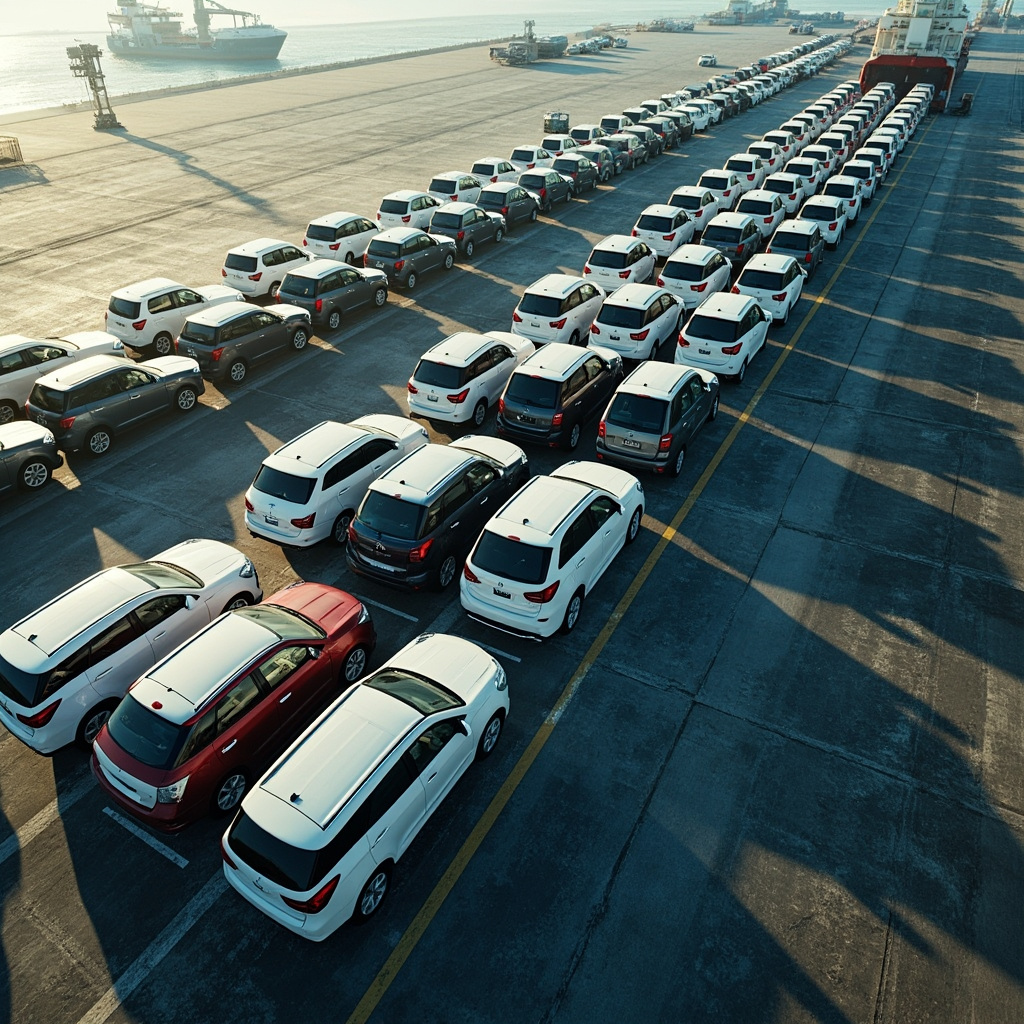
China's automotive exports have experienced explosive growth in recent years. Exports exceeded 2 million vehicles in 2021, surpassed 3 million in 2022, and in 2023 actually overtook Japan to become the world's number one automotive export country. Among these, new energy vehicles are the most core growth engine, with brands like BYD, Chery, SAIC, and Geely accelerating their electric vehicle models to Europe, Southeast Asia, and South American markets. Behind this export wave, a previously overlooked logistics artery is承受 unprecedented pressure—ocean-going ro-ro (Roll-on/Roll-off) vessel capacity is falling into sustained tightness.
Ro-Ro vessels are the mainstream ship type for transporting complete vehicles. Cars are driven into the hold, stacked layer upon layer, and driven out in sequence during departure—no rigging required, and the risk of scratches to vehicles is much lower than container transport. This characteristic makes it the preferred carrier for automotive exports. However, the expansion rate of the global ro-ro fleet has fallen far short of the pace of China's automotive export explosion.
The global ro-ro market has long been in a tight supply-demand balance. Long shipbuilding cycles, dense new vessel order schedules, and limited shipbuilding capacity together restrict rapid capacity replenishment. A large ro-ro vessel typically takes three to four years from order to delivery, and there is a clear mismatch between the startup time of this export boom and the release time of shipbuilding capacity.
New energy vehicles have higher requirements for ro-ro vessels. Battery safety regulations limit the stacking layers for electric vehicles during maritime transport, with some routes requiring single-vessel loading to be controlled below a certain proportion. At the same time, electric vehicles have stricter requirements for cabin temperature control systems and charging facilities, further compressing effective capacity.
Freight rates have soared accordingly. Taking the China-to-Europe route as an example, before 2020, ro-ro vessel freight rates were relatively stable; thereafter, as export demand surged and cabin space became scarce, rates increased several times. Some automotive companies even chartered entire ro-ro vessels to secure capacity, with the resulting logistics costs being staggering.
Facing the capacity bottleneck, OEMs and logistics providers are showing their各自的 abilities. Head enterprises like SAIC and BYD are layouting fleet operations—BYD has ordered several large dual-fuel ro-ro vessels, and SAIC's Anji Logistics continues to expand capacity. This "self-built fleet" strategy essentially internalizes logistics capabilities to hedge against external rate volatility.
At a broader trade level, automotive exporters are optimizing logistics combinations. Railway transport (via China-Europe Railway Express) has become an alternative for some European markets; container transport—disassembling vehicles into parts or directly loading them into containers—fills gaps in ro-ro capacity in specific scenarios, although the latter is not the optimal solution for protecting new vehicles.
Port ends are also accelerating adaptation. Tianjin, Shanghai, Guangzhou and other automotive export hub ports are newly building or upgrading professional automotive terminals to improve loading/unloading efficiency and yard capacity. Shortening ro-ro vessel port dwell time itself is an indirect release of capacity.
New ro-ro vessel orders have increased significantly in recent years, and the delivery wave is expected to gradually arrive after 2025, at which point the capacity tension may ease somewhat. However, it should be noted that the global automotive trade pattern is restructuring, and the increasing penetration rate of new energy vehicles will continuously create new logistics demands. The game between old capacity structure and new trade demand will continue.
The scale expansion of China's automotive exports has brought profound changes and pressure to the logistics industry chain while also giving birth to new business models and investment opportunities. In this battle from "can manufacture" to "can transport," ro-ro vessels may be one of the most underestimated key variables.
---
配图:远洋滚装船靠泊港口,汽车驶入船舱,摄影
---
【图片信息】
- 正文图片:image-1---b0cd79da-fe25-41c2-a82c-67beaa9ed4a5.png
- 缩略图:image-1---9021d630-0eb5-48e4-adb2-79266182927f.png




China——Brazil Trajectory Tracking



+86 532-85066033/34






 中文简体
中文简体 ENGLISH
