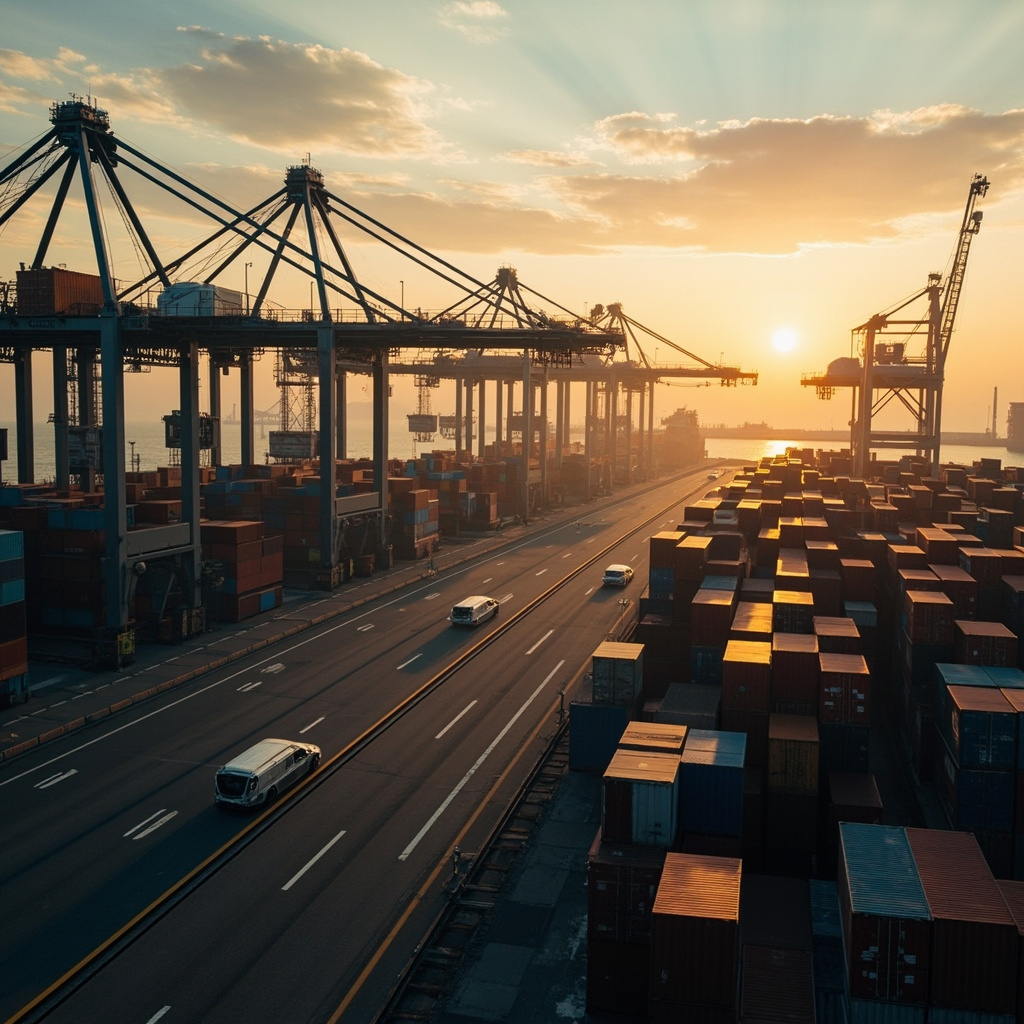
【Industry Trends】 In recent years, major ports around the world have been undergoing an unprecedented automation transformation. From Singapore to Dubai, from Rotterdam in the Netherlands to Shanghai in China, automated terminals have moved from concept verification to large-scale deployment. This technological revolution is profoundly changing the operational logic of global supply chains, bringing both new opportunities and challenges for cross-border logistics enterprises.
Traditional port operations have long relied on large amounts of manual labor. Bridge crane operators need to perform visual operations at heights of dozens of meters for extended periods, while crane operators repeat tens of thousands of precise movements in cramped cabs. However, the emergence of automated terminals has completely changed this situation. At fully automated container terminals, driverless Automated Guided Vehicles (AGVs) shuttle between yard blocks, intelligent quay cranes complete precise grabs guided by artificial intelligence vision systems, and the entire operational process achieves full数字化管控.
Globally, the construction of automated container terminals is gaining momentum. Some established European ports have upgraded traditional terminals to semi-automated or fully automated operations through technological transformation; emerging Asian economies are directly planning and constructing new port areas according to intelligent standards. This differentiated path selection reflects the diverse considerations of different regions regarding labor force structure, capital strength, and industrial upgrading needs.
The reason port automation has achieved large-scale implementation in recent years lies in substantial breakthroughs in multiple core technologies. High-precision satellite positioning systems provide centimeter-level positioning accuracy for unmanned handling equipment, ensuring the safety and reliability of automated operations. AI vision technology enables quay cranes to accurately identify container locking conditions and ship bay layouts, significantly reducing misoperation rates.
The commercial deployment of 5G networks has provided a solid foundation for real-time transmission of massive data within port areas. Under traditional 4G conditions, network latency for port equipment struggled to meet real-time control requirements, while 5G networks can control end-to-end latency within 10 milliseconds, creating conditions for remote control and intelligent decision-making. Some ports have begun exploring migrating certain control functions to the cloud, further reducing the technical complexity of on-site equipment.
Actual operational data confirms the efficiency advantages of automated terminals. Taking a certain large Asian automated container terminal as an example, its average bridge crane operation efficiency has exceeded traditional manual terminal levels, and with the accumulation of system learning capabilities, efficiency continues to improve. Around-the-clock continuous operation capability gives automated terminals of equivalent scale a significant advantage in annual throughput.
More importantly, automated terminals demonstrate performance in safety and stability that traditional terminals cannot match. Operation accidents caused by human factors have been greatly reduced, equipment utilization rates have significantly improved, and responses to and handling of sudden failures are more timely and precise. For cross-border trade enterprises requiring stable logistics timeliness, this predictable operational certainty has important commercial value.
Automated terminals do not simply eliminate jobs but redefine the skill structure of positions. Traditional high-altitude operation positions are shifting toward equipment maintenance, system monitoring, and data analysis. Port operating enterprises need to recruit new-type talent with electromechanical integration backgrounds and digital skills to adapt to new operational models.
At the same time, automation has also created new service demands. Equipment manufacturers, system integrators, and maintenance service providers have gained new development space in the industry chain. Higher vocational education institutions in port areas are also adjusting their curriculum to train technical talent suited to automated terminal operational needs.
The current main form of port automation is still "automation replacing repetitive labor," while the direction of the next stage is "intelligence optimizing global decision-making." AI systems are being used for predicting ship arrival times, optimizing yard container layout, and coordinating horizontal transport vehicle routes in high-complexity decision scenarios. With the improvement of data accumulation and algorithmic capabilities, intelligent systems are expected to surpass human experiential judgment in more dimensions.
The application of digital twin technology provides port operators with more powerful planning tools. By constructing virtual models corresponding one-to-one with physical terminals, operators can simulate the effects of various operational plans in digital space, evaluate optimization opportunities before implementation, and reduce decision risks. This virtual-real integrated operational model is becoming a new trend in industry development.
The acceleration of global port automation means faster customs clearance speeds and more stable vessel schedule connections for cross-border logistics enterprises. While improving their own throughput efficiency, automated terminals also provide better container collection and distribution conditions for mainline shipping companies, indirectly promoting overall efficiency improvements in maritime transportation channels.
For freight forwarding enterprises, understanding and tracking the automation development status of destination ports is becoming an important component of service capabilities. There are differences between automated and manual terminal operating rules, and cargo declaration, container management, and document processing may all involve new technical interfaces and procedure requirements. Mastering these changes in advance helps provide more precise logistics solutions for customers.
---
配图:Modern automated container terminal panoramic view, quay cranes and unmanned AGVs at sunset, photography
---
【图片信息】
- 正文图片:image-1---5aa5ba53-16cd-4c0b-a513-180f3acf794b.png
- 缩略图:image-1---11ddff53-c1b6-4498-96ad-b42a9974fd24.png




China——Brazil Trajectory Tracking



+86 532-85066033/34






 中文简体
中文简体 ENGLISH
