Abstract
In 2026, Brazil's corn exports experienced historic explosive growth. According to the latest data from Brazil's Foreign Trade Secretariat (SECEX), cumulative corn exports from January to May 2026 reached a record 28.6 million metric tons, representing approximately 627% growth compared to approximately 3.95 million metric tons during the same period in 2025, with export value reaching approximately USD 6.8 billion. Behind this stunning growth lies the superimposition of multiple short-term factors and long-term structural changes: a record Brazilian corn harvest in the 2025/26 season, increased certainty of Chinese buyers shifting to Brazilian corn, supply contraction from U.S. corn reduced by drought, and sustained instability in Ukrainian corn exports after the Black Sea grain agreement termination.
Brazil's explosive corn export growth is profoundly reshaping the established global grain trade landscape—the traditional "United States-Ukraine-Brazil" three-pole export pattern is evolving toward a new "Brazil-dominated" bipolar pattern. As the world's largest corn importer, China shifting its procurement center of gravity will serve as the core driver of this pattern change, and Chinese feed and processing enterprises' corn procurement strategies from Brazil will consequently face systemic adjustments.
This article provides comprehensive analysis of 2026 Brazilian corn export explosion from five dimensions—export data interpretation, growth driver analysis, global competitive landscape reshaping, Chinese importer response strategies, and future trend outlook—thoroughly explaining the deep logic behind the 627% surge in Brazilian corn exports, serving as a decision-making reference for practitioners engaged in international grain trade and corn import businesses.
Section 1: In-Depth Interpretation of 2026 Brazilian Corn Export Data
1.1 Historic Breakthrough in Export Scale
Brazil's corn export volume in the first five months of 2026 reached 28.6 million metric tons, a figure exceeding Brazil's entire 2024 corn export total (approximately 21 million metric tons) and surpassing even the most optimistic market forecasts for 2026 full-year exports. If this growth momentum continues through the remainder of the year (June to December is typically Brazil's corn export off-season, as soybean exports occupy port capacity), 2026 full-year Brazilian corn exports are expected to exceed 32 million metric tons, setting a historical record for Brazilian corn exports.
From monthly data perspective, March 2026 was the most stunning month—approximately 9.5 million metric tons, accounting for approximately one-third of total exports in the first five months, becoming the highest single-month export volume in Brazilian corn export history. This figure even exceeds Ukraine's monthly average export level, marking that Brazil's position in the global corn export market has undergone a qualitative leap.
From export destination perspective, 2026 Brazilian corn exports are highly concentrated. According to SECEX statistics, from January to May 2026, the distribution of Brazil's corn export destinations is as follows: mainland China accounts for approximately 68%, making it the largest export market for Brazil; Iran approximately 8%; Vietnam approximately 5%; South Korea approximately 4%; and other destinations (including Bangladesh, Egypt, and Malaysia) account for the remaining approximately 15%.
1.2 Price Trends and Market Structure
While export volume surged, Brazilian corn FOB prices at Santos Port showed a trend of first rising then falling. From January to February 2026, driven by global corn supply-demand tight balance expectations, Brazilian corn FOB quotes were approximately USD 210–220 per metric ton, the highest level for the same period in nearly three years. After March, as Brazil's harvest expectations progressively materialized and Black Sea region supply pressure eased, prices retreated to the USD 185–200 per metric ton range.
From export quality structure perspective, 2026 Brazilian corn exports are primarily Second Yellow Corn, with average protein content approximately 8.5%, moisture content approximately 13.5%, and impurity content approximately 1%, overall quality meeting Chinese feed industry procurement standards. Some batches have shown fluctuations in sanitary indicators such as DON (vomitoxin) and aflatoxin B1, requiring importers to clearly stipulate inspection standards and compensation mechanisms in procurement contracts.
1.3 Export Structure and Logistics Bottlenecks
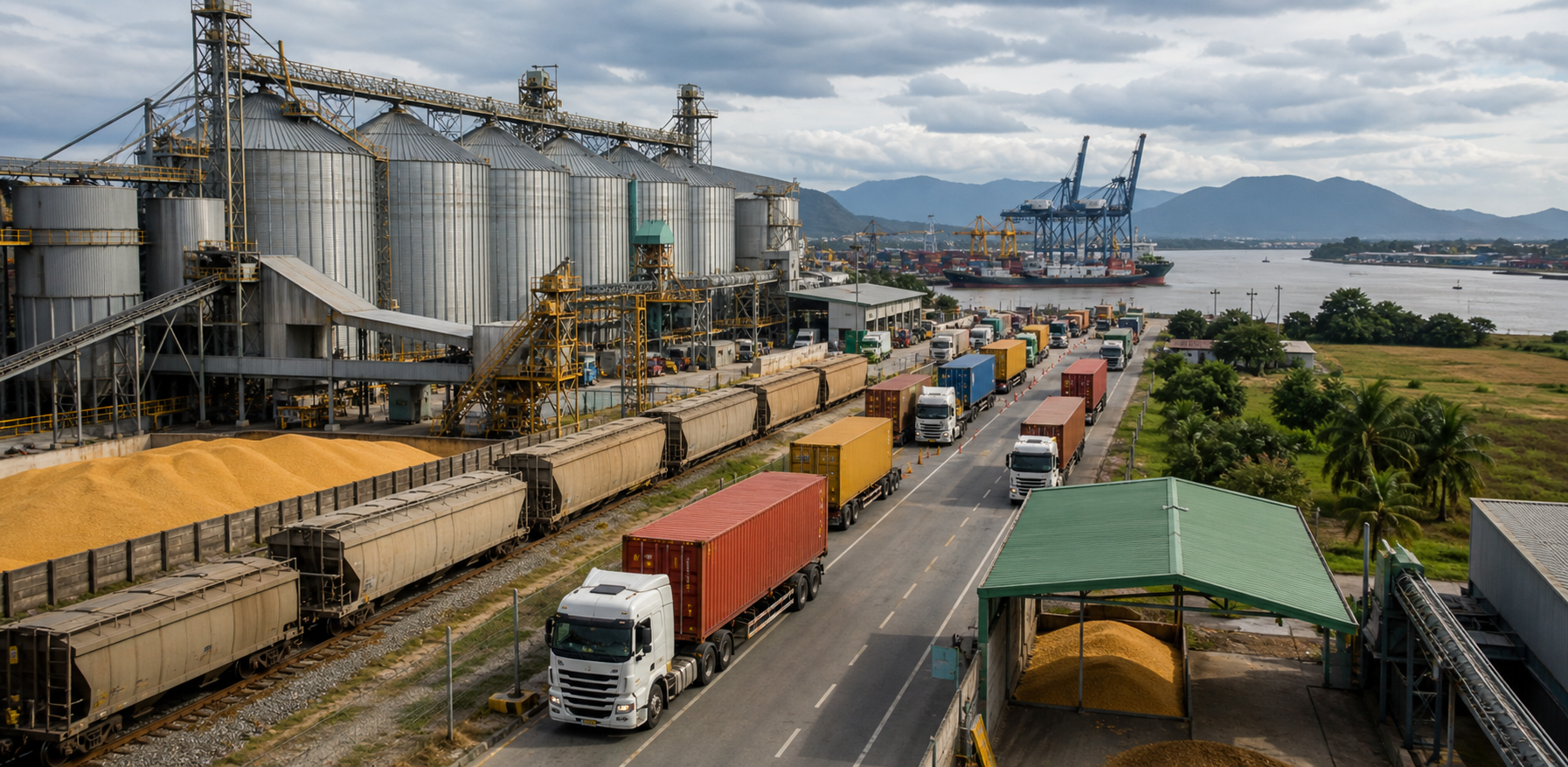
Brazil's explosive corn export growth also exposed structural bottlenecks in its logistics infrastructure when handling concentrated bulk agricultural exports. Similar to soybean exports, corn exports highly depend on Santos Port and Paranaguá Port as the two major hub ports. In March 2026, when corn and soybean exports simultaneously peaked, competition between the two bulk commodity categories caused port pressure to surge abruptly.
Corn, as a bulk commodity transported via bulk carriers, its loading and unloading efficiency at ports directly affects vessel turnaround time. In March 2026, Santos Port's average loading time for corn extended from the normal approximately 3 days to approximately 5–6 days, with some vessels waiting for berths exceeding 8 days. For Chinese buyers, this means actual in-transit time for imported corn (from Brazilian ports to Chinese ports) extended from the normal approximately 35 days to 45–55 days, adding extra complexity to inventory management and procurement planning.
Section 2: In-Depth Analysis of Growth Drivers
2.1 Harvest Cycle and Planting Area Expansion
The 2025/26 crop year was a bumper year for Brazilian corn. According to the Brazilian National Company for Food Supply (CONAB) supply and demand report published in June 2026, 2025/26 Brazilian corn total production is expected to reach approximately 132 million metric tons, representing approximately 29% growth from the previous crop year (approximately 102 million metric tons), setting a historical record. Main drivers of the production increase include:
Expanded planting area: 2025/26 Brazilian corn planting area is approximately 21.5 million hectares, approximately 2 million hectares more than the previous crop year. Area expansion primarily came from second-crop corn (Safrinha, accounting for approximately 70% of Brazil's total corn production) promotion in traditional soybean-producing regions of the Midwest after soybean harvest, plus contributions from newly developed production regions in northeastern states such as Piauí and Maranhão.
Improved per-unit yield: National average yield is approximately 6.1 metric tons per hectare, approximately 7% higher than the previous crop year. Southern Brazil regions (Paraná, South Mato Grosso) had favorable climate conditions with notably above-average corn yields; Midwest core production regions also maintained stable yield growth.
Advancement in planting technology: Widespread adoption of precision agriculture, hybrid seeds, and biofertilizers continuously drives long-term growth in Brazilian corn per-unit yields. Corn varieties promoted by Brazilian Agricultural Research Company (Embrapa) have continued improving in drought resistance and disease resistance, providing scientific and technological support for yield enhancement.
2.2 Increased Certainty of Chinese Buyers Shifting to Brazil
Increased certainty of Chinese buyers shifting to Brazilian corn is the most critical demand-side driver behind Brazil's 2026 corn export explosion. This shift is backed by three layers of structural logic:
Layer 1: Strategic need for supply diversification. China, as the world's largest corn importer (annual import volume approximately 28–30 million metric tons, approximately 15% of global corn trade), faces significant structural risk from over-dependence on a single supply country. Between 2022 and 2023, China's dependence on U.S. corn once reached approximately 80%, and this highly concentrated procurement structure became extremely fragile amid escalating U.S.-China trade friction. In 2023, China's anti-dumping investigation on U.S. corn and sharp drop in import volume clearly demonstrated the urgency of supply diversification.
Layer 2: Brazilian corn quality and price competitiveness. Brazilian corn is basically on par with U.S. corn in protein content, impurity content, and other quality indicators, with some indicators actually superior. Simultaneously, Brazilian corn FOB prices are persistently lower than U.S. corn (approximately 5%–10% lower), benefiting from Brazil's weak real currency (2026 average exchange rate approximately 1 USD to 5.2 reais) and Brazil's higher corn production efficiency. For Chinese feed enterprises, Brazilian corn offers significant landed cost advantages.
Layer 3: Institutional guarantees from bilateral trade agreements. In 2025, China and Brazil signed phytosanitary protocols and mutual veterinary health certificate agreements for corn trade, sweeping away critical quarantine barriers for large-scale Brazilian corn entry into the Chinese market. Previously, Brazilian corn entering the Chinese market required applying for quarantine permits ship-by-ship with lengthy processes; under the new agreement framework, eligible Brazilian corn exporters can enjoy "fast track" quarantine treatment with substantially shortened clearance time.
Combining the above factors, Chinese buyers substantially increased corn procurement from Brazil in 2026—importing approximately 19.5 million metric tons of Brazilian corn in the first five months, accounting for approximately 68% of Brazil's total corn exports, compared to only approximately 35% during the same period in 2025.
2.3 U.S. Production Reduction and Global Supply Tightening Resonance
U.S. corn production reduction is another important factor driving global corn price and trade flow changes in 2026.
In 2026, U.S. corn main production regions experienced severe drought and high-temperature weather, causing corn good-to-excellent rating to persistently remain at historically lowest levels for the same period. According to the U.S. Department of Agriculture (USDA) Global Agricultural Supply and Demand report published in June 2026, U.S. corn production in the 2025/26 crop year is expected to be approximately 365 million metric tons, approximately 12% lower than the previous crop year. U.S. corn export supply contraction pushed up U.S. corn FOB quotes and Chinese buyer import costs for U.S. corn, further strengthening Chinese buyers' motivation to shift to Brazilian corn.
From the perspective of overall global corn trade, U.S. production reduction and Brazilian bumper harvest formed a stark contrast—South American (Brazil and Argentina) corn supply abundance filled the global demand gap left by U.S. production reduction. This structural supply-demand change is driving global corn trade transformation from a "U.S.-dominated" pattern toward an "South America-dominated" pattern.
2.4 Sustained Impact of Black Sea Supply Uncertainty
In 2026, the Black Sea region's grain export landscape remains filled with uncertainty. After the Black Sea Grain Initiative expired in 2025, Ukrainian grain exports faced more logistical obstacles—Black Sea port operations were affected by geopolitical factors, vessel insurance and freight costs rose substantially, and traders and buyers' risk premium requirements for Black Sea corn significantly increased.
According to shipping broker Braemar's data, in the first half of 2026,即时运费 for Ukrainian corn to Chinese ports was approximately USD 8–12 per metric ton higher than Brazilian corn (due to risk premiums and insurance costs), placing Ukrainian corn at a competitive disadvantage in pricing. Additionally, some Chinese buyers have concerns about Black Sea corn quality stability, further driving procurement preference toward Brazilian corn.
Section 3: Global Grain Trade Pattern Reshaping
3.1 From "U.S.-Brazil-Ukraine" Three-Pole to "Brazil-Dominated" New Pattern
The global corn export market traditionally presented a "United States-Ukraine-Brazil" three-pole pattern: the United States has long held the position of the world's largest corn exporter, with market share approximately 25%–30%; Ukraine approximately 15%–20%; Brazil approximately 20%–25%. 2026 data indicates this pattern is undergoing profound change—Brazil's market share is expected to rise to approximately 30% in 2026, surpassing the United States to become the world's largest corn exporter.
The fundamental force driving this pattern reshaping is structural supply-demand changes: U.S. domestic corn demand (particularly ethanol production corn demand) continues growing, with limited room for growth in exportable supply; Brazil's corn production potential far exceeds current output—Brazil's Ministry of Agriculture's long-term planning shows that by 2030, Brazilian corn production could reach 180 million metric tons, with approximately 40 million metric tons available for export. This means Brazilian corn export expansion has sustainable structural support, not merely relying on a single crop year's bumper harvest.
3.2 China's Dominant Position and Impact in Global Corn Trade
The China factor is the core variable reshaping global corn trade patterns. In 2026, China's corn import volume is expected to be approximately 29 million metric tons, approximately 16% of global corn trade. This massive import volume gives Chinese buyers significant pricing influence in the global corn market.
Chinese buyers' procurement preferences have decisive impact on each exporting country's market share. Using January–May 2026 data as an example, China imported approximately 19.5 million metric tons of corn from Brazil (68% of Brazil's exports), approximately 2.8 million metric tons from the United States (only approximately 8% of the U.S.同期 exports), and approximately 1.8 million metric tons from Ukraine. This change in procurement structure directly drove Brazil's corn export explosion and relative shrinkage of U.S. corn exports.
Looking at the long term, Chinese buyers will likely maintain a "primarily Brazil, supplemented by United States, with Ukraine as supplement" procurement structure, providing sustained stable demand support for Brazil's corn industry.
3.3 Adaptive Changes in Regional Trade Routes and Logistics Infrastructure
Global corn trade pattern reshaping is driving adaptive changes in regional trade routes and logistics infrastructure.
On the Atlantic-Indian Ocean route, large-scale Brazilian corn exports to China have driven infrastructure upgrade and expansion at southern Brazilian ports (Santos Port, Paranaguá Port, and Rio Grande Port). Port operators increased investment in bulk loading and unloading equipment, improving corn loading efficiency. Shipping companies (such as Vale Logistics and BHP Logistics) also increased dedicated corn route sailings to China, pushing Atlantic-Indian Ocean route capacity up by approximately 20%.
On the U.S. Gulf of Mexico route, relative shrinkage of U.S. corn export volume has caused some bulk loading facilities at Gulf ports to face idle pressure. Some ports have begun adjusting business focus, shifting more capacity toward soybeans and other agricultural products.
On the Black Sea route, Ukrainian corn export logistical obstacles accelerated the "de-Black Sea" trend in Black Sea grain trade—an increasing proportion of Ukrainian corn is being exported via Danube barge transport to Romania's Constanța Port, bypassing the Black Sea main shipping lane, which has to some extent changed the Black Sea grain trade logistics landscape.
Section 4: Chinese Importers' Response Strategies and Risk Management
4.1 Systemic Adjustment of Procurement Strategies
The 2026 explosive growth in Brazilian corn exports requires systemic adjustment of procurement strategies for Chinese corn importers.
Adjustment 1: Establish long-term Brazilian corn procurement framework. Chinese importers should elevate cooperation with Brazilian suppliers from "occasional inquiry" to "strategic framework agreement" level. Using long-term procurement framework agreements (LTA), importers can lock in procurement volume and pricing for the next 1–3 years, reducing market volatility risk. Using a Chinese leading feed enterprise's practice in the first half of 2026 as an example, it signed annual framework agreements with three major Brazilian exporters, locking in approximately 3 million metric tons of annual procurement volume at an average price approximately 8% lower than the spot market, achieving significant cost savings.
Adjustment 2: Optimize "Brazil + United States" combined procurement structure. Although Brazil has become the primary source for Chinese corn imports, U.S. corn still holds certain supply supplementary value during non-peak seasons (such as each year before the first half's new crop corn listing). It is recommended that Chinese importers, while maintaining Brazil-dominant procurement, retain a certain proportion of U.S. corn procurement quota (approximately 15%–20%) to address Brazil's supply seasonal fluctuations and sudden interruption risks.
Adjustment 3: Establish supplier diversification system. Beyond Brazil and the United States, Chinese importers should also monitor potential supply sources including Argentina, Ukraine, and South Africa, dispersing single supplier dependence risk. Argentine corn has seasonal export advantages from March to June each year, forming seasonal complementarity with Brazilian corn; Ukrainian corn can serve as a supplementary source when pricing is suitable; South African corn can provide export capacity to China in specific years.
4.2 Refined Management of Logistics and Transportation Costs
As a bulk commodity, logistics costs account for approximately 15%–20% of landed costs for corn, making refined management of logistics and transportation costs an important component of procurement cost control.
Strategy 1: Use ocean freight futures to hedge freight risk. Capesize and Panamax vessel charter rates are highly volatile. Using the route from Santos Port to Qingdao Port, China as an example, charter rate volatility in the first half of 2026 ranged approximately USD 15–45 per metric ton, a relatively large fluctuation. Chinese importers can use ocean freight futures (such as FFA—Forward Freight Agreements) or option instruments to lock in major route freight, reducing freight volatility's impact on procurement costs.
Strategy 2: Optimize shipping schedules to avoid port congestion叠加 costs. March 2026 port congestion in Brazil causing demurrage and additional freight expenses is a lesson. It is recommended that Chinese importers coordinate shipping plans with Brazilian suppliers in advance, arranging shipping times during off-seasons (June–October) to avoid peak season when soybeans and corn exports simultaneously peak, obtaining more favorable freight rates and faster vessel turnaround.
Strategy 3: Evaluate applicability of FOB versus CFR terms. For Chinese importers with ocean freight booking capabilities, FOB terms provide greater freight control space; for smaller importers or those lacking ocean freight operational experience, CFR terms transfer freight risk to suppliers. Although procurement prices may be slightly higher, this eliminates operational complexity of self-booking. Enterprises should select appropriate trade terms based on their own capabilities rather than blindly pursuing lowest cost.
4.3 Quality Control and Risk Prevention
Quality control in Brazilian corn import process is an important link in preventing procurement risks. The following are several key risk prevention points:
Risk 1: DON and aflatoxin exceeding standards. Brazilian corn faces risks of mycotoxin contamination during harvest and storage, especially in regions with humid climates. It is recommended to clearly stipulate toxin inspection standards in procurement contracts (such as Chinese national standard GB 2761-2017 requirements for DON and aflatoxin B1 limits), and conduct independent inspections at both loading and destination ports. Once inspection results exceed standards, claims can be filed per contract terms.
Risk 2: Moisture and impurity exceeding standards. If Brazilian corn's moisture and impurity indicators at loading exceed contract stipulations, it affects buyer interests and causes port clearance tax losses. It is recommended that contracts stipulate destination port inspection results as final settlement basis, with clearly agreed deduction and pricing formulas.
Risk 3: Weight shortage. Some Brazilian exporters may have short-loading situations at ports, causing destination weight to be lower than contract quantity. It is recommended that contracts stipulate destination port scale weight as final settlement weight, retaining the right to apply for impartial re-inspection from inspection agencies.
Section 5: Future Trend Outlook
5.1 Long-Term Growth Potential of Brazilian Corn Industry
Looking long-term, Brazilian corn industry's growth potential is far from exhausted. Brazil's Ministry of Agriculture planning shows Brazilian corn planting area still has approximately 30 million hectares of developable land resources, primarily concentrated in newly developed production regions in central-northern and northeastern areas. Relying on planting technology advancement and land expansion, 2030 Brazilian corn production could reach 160–180 million metric tons, with export capacity correspondingly increasing to 35–45 million metric tons.
This growth potential means Brazil will sustainably consolidate its position as the world's largest corn exporter over the next decade. For Chinese importers, establishing long-term stable strategic cooperation relationships with Brazilian corn suppliers is not only a current business need but also a long-term strategic布局.
5.2 Sustained Evolution of Global Grain Trade Patterns
The 2026 explosive growth in Brazilian corn exports is a microcosm of deep reshaping in global grain trade patterns. This reshaping process will continue to deepen over the coming years:
The United States' global corn export market share will face sustained pressure. U.S. domestic corn consumption (ethanol, feed, food) continues growing, with limited room for growth in exportable surplus. It is estimated that by 2030, U.S. corn export volume as a proportion of global trade will decline from the current approximately 25% to approximately 18%–20%.
South American (Brazil and Argentina) export shares will continue expanding. After Argentina's new government took office and promoted agricultural policy reform, corn export taxes were reduced from 12% to 6%, and farmers' planting enthusiasm increased. Argentine corn production is also expected to grow steadily. Combined Brazil and Argentina are expected to account for approximately 45%–50% of global corn export market share by 2030.
Black Sea region's export share and logistical channels will face sustained uncertainty. Global grain traders and buyers will gradually reduce dependence on Black Sea corn, turning toward more stable South American supply sources.
5.3 China's Strategic Positioning
As the world's largest corn importer, China should thoughtfully consider its strategic positioning in the global grain trade pattern reshaping.
From the supply security perspective, China needs to continuously promote procurement source diversification, moving beyond over-dependence on a single country. Brazil, as the most reliable long-term supply cooperation partner, its strategic value will continuously rise as the foundation of bilateral cooperation deepens.
From the price discourse power perspective, China's massive import volume gives Chinese buyers important pricing influence in the global corn market. Through combinations of long-term framework agreements and futures market tools, Chinese buyers have the capability to strive for greater discourse power in the global corn pricing system.
From the industrial coordination perspective, Chinese corn importers can consider making moderate sovereign investments in Brazilian production regions (such as signing "floor purchase price" agreements with Brazilian farmers and taking equity stakes in port infrastructure), more deeply binding stable supply of Brazilian corn while capturing value returns from the upstream supply chain.
Trends and Outlook
The 627% surge in Brazilian corn exports in 2026 is both a product of the 2025/26 bumper harvest, global supply structural changes, and geopolitical factor superimposition, and also a landmark event in the long-term reshaping process of global grain trade patterns. Brazil is evolving from "one of the world's granaries" to "the world's primary granary" with its enormous agricultural production potential, playing an increasingly irreplaceable role in the global corn market.
For Chinese corn importers and feed enterprises, embracing this pattern change, establishing deep cooperation relationships with Brazilian suppliers, and enhancing capabilities in global grain market resource allocation are the only paths to addressing future food security challenges. For international logistics and freight forwarding service enterprises, the massive business increment brought by Brazilian corn export logistics, along with supporting port infrastructure upgrades, inland logistics optimization, and ocean shipping channel construction, will all create substantial market opportunities. In this great transformation of the global grain trade pattern, opportunities and challenges coexist, and only those who carefully position themselves can seize the initiative.






China——Brazil Trajectory Tracking



+86 532-85066033/34






 中文简体
中文简体 ENGLISH
