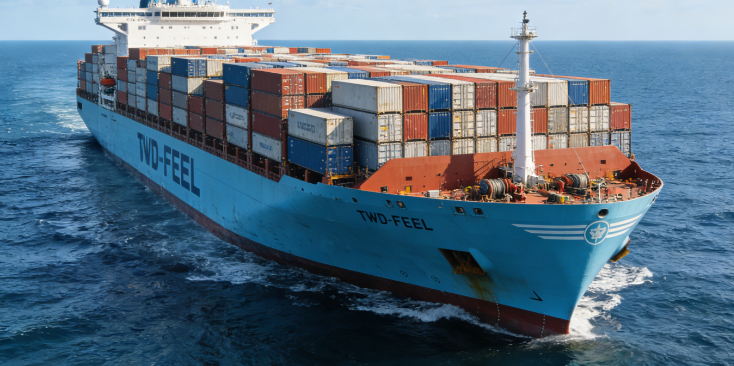
Danish shipping giant Maersk is continuously exploring the possibility of diversified low-emission fuel combinations, testing the application of ethanol fuel on methanol dual-fuel engines.
Recently, Maersk announced that following a successful initial trial, the company will conduct a new round of tests on the 2100 TEU methanol dual-fuel feeder vessel "Laura Maersk," planning to use a 50% ethanol and 50% methanol blended fuel (E50). This marks the world's first methanol dual-fuel container ship.
Previously, the "Laura Maersk" underwent initial trials in October and November, using a fuel blend of 10% ethanol and 90% e-methanol (e-methanol), confirming that ethanol can be safely and effectively integrated into the fuel system. This test underscores the potential for creating more options for Maersk's methanol dual-fuel fleet, essentially expanding the fleet to "dual-fuel alcohol vessels."
According to Maersk, since ethanol and methanol are both alcohols, they share similar physical and combustion characteristics. The core objective of the initial trial was to verify if the E10 (10% ethanol) fuel blend could ignite and combust as effectively as pure methanol fuel while maintaining comparable lubricity and corrosion levels.
The test results confirmed that ethanol can be mixed with methanol fuel without impacting engine performance, paving the way for future use of higher ethanol ratios. In addition to the upcoming E50 testing, Maersk also plans to conduct trials with 100% ethanol fuel. It is reported that Maersk will further scale up pilot testing on the Far East to Northwest Europe route in 2026.
Maersk is using anhydrous ethanol in the tests, the same type of ethanol used in several countries globally for blending with gasoline. Given the maturity of the ethanol market, this offers Maersk more possibilities to achieve its climate goals. Currently, Maersk is evaluating the potential role of first-generation (crop-based) fuels like ethanol in transitional fuel systems. Evaluation criteria include greenhouse gas lifecycle emissions, traceability, certification standards, and responsible sourcing practices.
Emma Mazhari, Head of Energy Markets at Maersk, stated, "At Maersk, we believe that a variety of fuel pathways are crucial for the shipping industry to achieve its climate goals. This means consciously exploring different options and technologies. Ethanol has a mature market and well-established infrastructure and is one of the additional pathways to decarbonization. By gradually increasing the ethanol ratio, we can gather valuable data on engine performance and combustion effects to inform future fuel procurement."
Aligned with Maersk's sustainability goals, the company aims to achieve carbon neutrality by 2040, setting it ahead of most of its industry peers by at least 10 years. Additionally, Maersk has set more immediate targets, requiring a 50% reduction in greenhouse gas emissions intensity for its deep-sea fleet by 2030 and a 70% reduction in absolute emissions for fully controlled terminals.




China——Brazil Trajectory Tracking



+86 532-85066033/34






 中文简体
中文简体 ENGLISH
