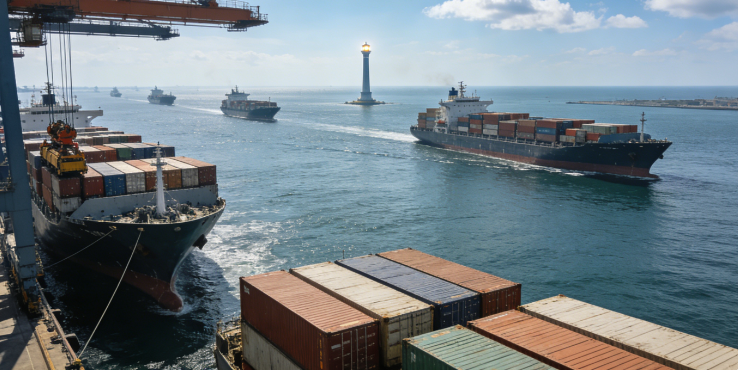
Global trade routes are becoming increasingly fragile, facing severe threats from human factors such as conflicts, piracy, terrorism, as well as natural disasters like extreme weather events.
According to a new study, disruptions at these critical nodes are projected to affect approximately $192 billion worth of maritime trade annually by the end of 2025, leading to around $14 billion in economic losses, including costs related to delays, rerouting, insurance expenses, and increased freight costs.
Published in the journal "Nature Communications," the study titled "Systemic Impacts of Disruptions to Maritime Traffic Corridors" was conducted by Dr. Jasper Verschuur, Dr. Johannes Lumma, and Professor Jim Hall from the Oxford Sustainable Infrastructure Systems project (OPSIS) at the Oxford University Environmental Change Institute (ECI), with the support of the Oxford Martin Programme on Global Resilience and the Gallagher Research Centre.
Researchers analyzed 24 crucial maritime chokepoints, including the Suez Canal, the Strait of Hormuz, and the Strait of Malacca, which are major arteries for global goods and energy transport. The study found that disruptions at these chokepoints would lead to approximately $10.7 billion in direct economic losses annually, equivalent to 0.04% of global trade. Countries highly dependent on vulnerable shipping lanes, such as Egypt, Yemen, Iraq, and Panama, would face the most significant impact.
Furthermore, the annual increase in shipping costs would result in global losses of around $3.4 billion. When trade routes are blocked or vessels are forced to reroute, freight costs escalate sharply. This cost impact would affect all countries, not just economies directly reliant on obstructed routes, ultimately raising transportation costs and transmitting to consumer prices.
Dr. Jasper Verschuur, the lead author of the study, remarked, "The lifelines of the global economy rely on a few maritime chokepoints. The disruption of any narrow channel would swiftly reverberate across continents. Understanding these risks is crucial for enhancing the resilience of global supply chains."
The study reveals a link between human-made threats such as armed conflicts, piracy, and natural disasters like hurricanes, particularly in critical regions like the Strait of Hormuz, the Bosporus Strait, and the Lombok Strait. Armed conflicts and terrorism often arise in these areas. Additionally, around 40% of tropical cyclones simultaneously impact multiple chokepoints. Pirate activities in one region increase the risk of attacks in other areas. These intertwined risks imply that multiple critical nodes could be paralyzed simultaneously, severely restricting the ability to reschedule global vessels and trade flow.
Dr. Johannes Lumma explained, "The intertwining of risks reveals the close connection within the maritime system. A single event in one region may trigger or exacerbate dangers in other regions. Analyzing these interconnections helps us predict compound impacts and prepare accordingly."
These findings underscore the systemic vulnerabilities of the global trade network. Disruptions at critical nodes could trigger chain reactions, from factory shutdowns due to component shortages to price hikes felt by global consumers.
To address these risks, the researchers suggest implementing layered resilience strategies tailored to the types of chokepoints that countries or businesses rely on. This may include establishing emergency reserves, diversifying supply chains, investing in security measures, and developing insurance products that cover rare but severe disruptions.
Professor Jim Hall, the lead author and co-author of OPSIS, stated, "While maritime corridors may have limited geographical scope, their impact on the global economy is profound. Ensuring their smooth operation and safety is a top priority globally. By identifying the most vulnerable links in the system, we can help governments and businesses enhance their capacity to respond to future disruptions."
Amid current geopolitical turmoil and climate change, this study emphasizes that the stability of international trade depends on the security of strategic shipping lanes. The researchers highlight that international cooperation and coordinated risk management will be essential prerequisites for preventing and mitigating future disruptions.




China——Brazil Trajectory Tracking



+86 532-85066033/34






 中文简体
中文简体 ENGLISH
