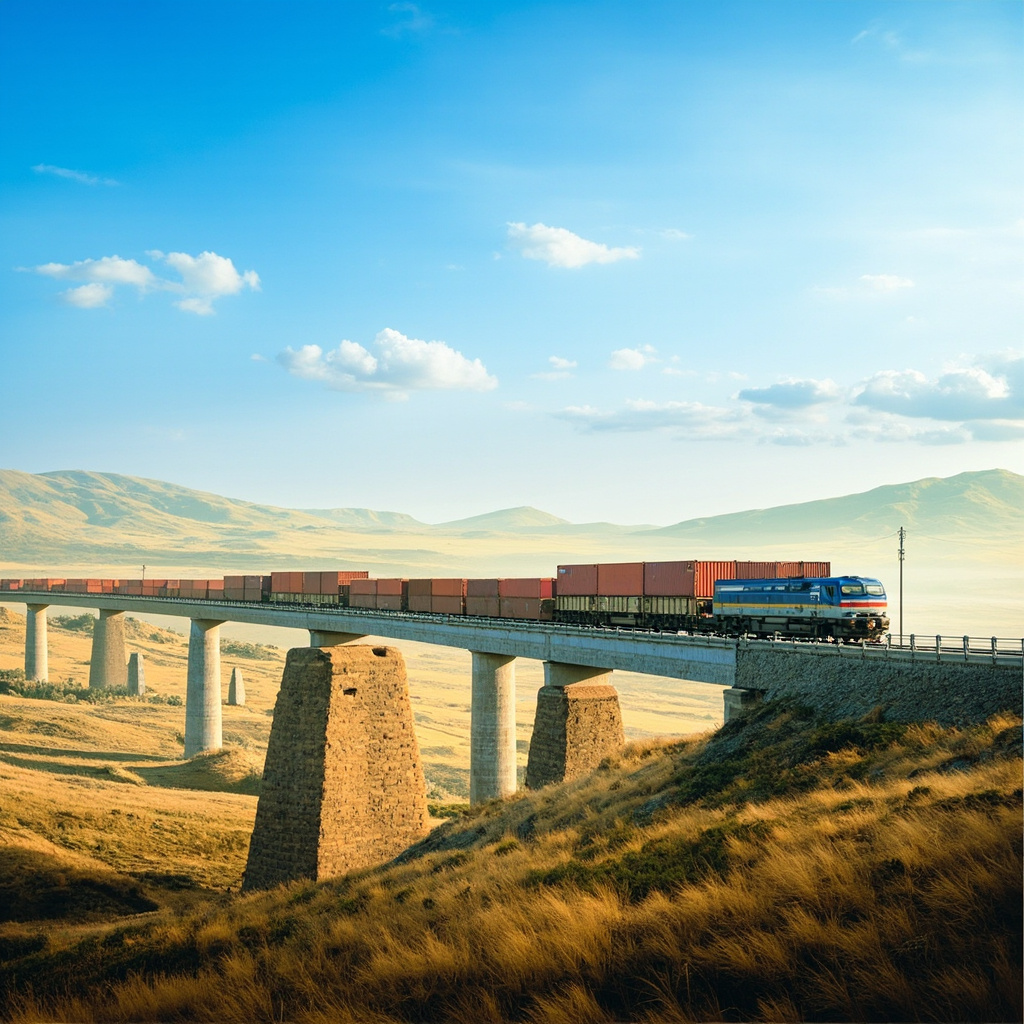
A decade ago, the China-Europe Railway Express was merely an initiative with political connotations; a decade later, it has become an indispensable artery in the Asia-Europe cargo landscape. According to recent data, the annual number of China-Europe Railway Express runs has exceeded 10,000, connecting more than a hundred cities in China with dozens of destination stations across over twenty European countries. This rail corridor spanning thousands of miles is profoundly changing the route choices for cargo transportation between Asia and Europe.
The rise of the China-Europe Railway Express is no accident. While maritime shipping has long dominated the international trade cargo market with its cost advantages, its time limitations have become increasingly prominent in the era of the rise of cross-border e-commerce and globalization of high-end manufacturing. A shipment from Shanghai to Europe by sea takes at least twenty days at the fastest; through the China-Europe Railway Express, this time can be compressed to twelve to eighteen days. For high-value-added goods and supply chain segments sensitive to timeliness, railways are increasingly competitive with shipping in terms of cost-effectiveness.
The China-Europe Railway Express is not a single route but a system of routes including the渝新欧, 郑新欧, 蓉欧, 长安号 and others. Each route relies on its respective city's industrial foundation, forming differentiated cargo source structures and competitive advantages.
Relying on the laptop industry, the渝新欧 route transports a相当大的 portion of global laptop production capacity to Europe via rail; Zhengzhou, with Foxconn as its leader, takes precision electronic products like mobile phones as core cargo; Chengdu, backed by the Southwest manufacturing cluster, exports machinery and automotive parts to Europe. In recent years, more and more enterprises from the Yangtze River Delta and Pearl River Delta have begun shifting some cargo demand from shipping to the China-Europe Railway Express, making the cargo source structure increasingly diversified.
At the overseas end, railway hubs like Brest (Malaszewicze) in Belarus and Małaszewicze in Poland have become key nodes for train transfer operations. The operational efficiency and customs facilitation level at these stations directly affect the end-to-end timeliness of trains. In recent years, countries along the route have continued to increase infrastructure investment, and hub congestion has improved, but bottlenecks remain.
The freight rate of China-Europe Railway Express is higher than shipping, but the gap is narrowing. Taking a 40-foot container from China to Europe as an example, shipping prices usually remain in the thousand-dollar range amid fluctuations, while China-Europe Railway Express rates range from several thousand to nearly ten thousand dollars. Although absolute costs are higher, considering reduced inventory capital occupation and improved supply chain response speed, the comprehensive cost accounting is being recalculated by more and more enterprises.
Particularly worth noting is the China-Europe Railway Express's stability advantage when应对 unexpected events. During the Suez Canal blockage event in 2021, large quantities of cargo shifted to railway channels, and China-Europe Railway Express rates rose sharply in the short term, which precisely demonstrated its strategic value as an alternative channel. When international air cargo nearly collapsed during the pandemic, the China-Europe Railway Express also undertook large volumes of emergency material transportation tasks, demonstrating high strategic reliability.
The development of China-Europe Railway Express has not been smooth sailing. Insufficient return cargo is a long-standing problem troubling the industry—high load factor on outbound trips, but chronically high empty container rate on return trips, restricting overall economic efficiency. Political risks along the route, varying degrees of customs facilitation, and gauge standard differences causing transfer costs are all structural factors restricting further efficiency improvement.
From a long-term perspective, the positioning of China-Europe Railway Express is evolving from "strategic supplement" to "mainstream channel." With the continuous deepening of the "Belt and Road" Initiative, the level of infrastructure connectivity along the route will continue to improve, and the facilitation of cross-border railway transportation is expected to continue improving. The establishment of digital train operation platforms is qualitatively changing the efficiency of cargo tracking, capacity matching, and cross-border document processing.
The story of the Asia-Europe Continental Bridge is far from its conclusion.
---
配图:铁路国际货运班列,货场夜景,集装箱堆叠,摄影
---
【图片信息】
- 正文图片:image-1---daf05969-d5f8-495b-bbce-ea24f60c751d.png
- 缩略图:image-4---f025b974-fd9a-469c-9743-b7200cbef066.png




China——Brazil Trajectory Tracking



+86 532-85066033/34






 中文简体
中文简体 ENGLISH
