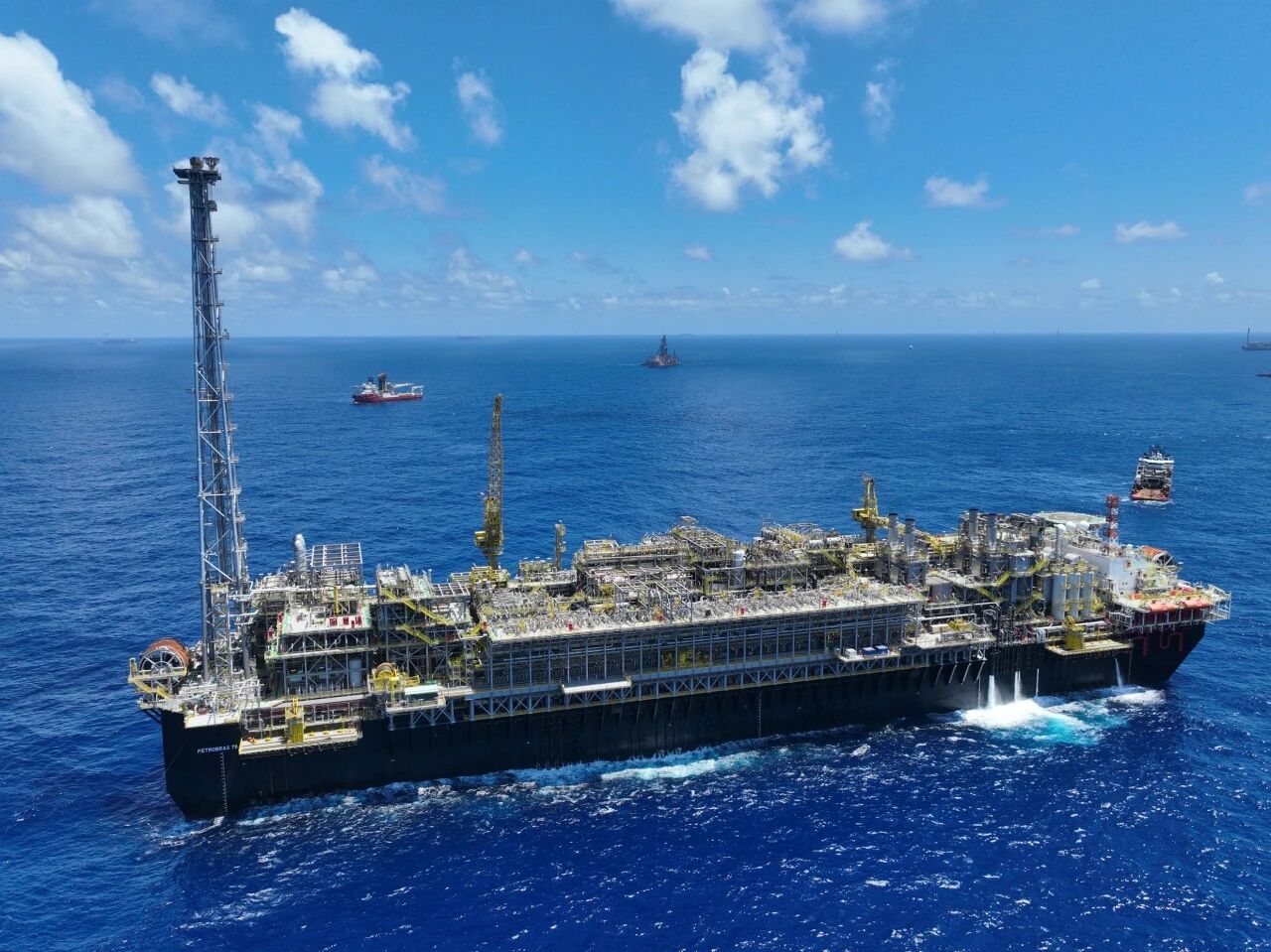
According to statistics released by the Brazilian National Agency of Petroleum, Natural Gas and Biofuels (ANP) on April 1, Brazil’s oil and natural gas output set a new record in February 2026.
The data shows that the country’s total oil and natural gas equivalent production reached 5.304 million barrels per day in the month, surpassing the previous monthly record of 5.255 million barrels per day set in October 2025.
For oil alone, February production stood at 4.061 million barrels per day, up 2.7% month-on-month and 16.4% year-on-year. Natural gas output reached 197.63 million cubic meters per day, rising 2.3% from the previous month and 24.5% from the same period last year.
The production came from 6,079 oil and gas wells, including 582 offshore wells and 5,497 onshore wells. Offshore fields accounted for 98% of Brazil’s total oil production and 87.8% of its natural gas output. Meanwhile, fields operated solely or jointly by Petróleo Brasileiro S.A. (Petrobras) contributed 89.46% of the national total.
Production from the deepwater pre-salt layer accounted for 80.2% of Brazil’s total output, reaching 4.243 million barrels of oil equivalent per day in February — an increase of 2.3% month-on-month and 20.1% compared with February 2025. This included 3.264 million barrels per day of oil and 155.56 million cubic meters per day of natural gas, all extracted from 181 pre-salt wells in deepwater basins.
The Tupi Field in Brazil’s offshore Santos Basin is the country’s largest oil and gas producing area, with daily output of 865,980 barrels of oil and 42.87 million cubic meters of natural gas.
Among Brazil’s offshore oil production platforms, the Almirante Tamandaré FPSO in the Búzios Field recorded the highest oil output at 197,900 barrels per day. The Marechal Duque de Caxias FPSO in the Mero Field registered the highest natural gas production at 12.37 million cubic meters per day.





China——Brazil Trajectory Tracking



+86 532-85066033/34






 中文简体
中文简体 ENGLISH
