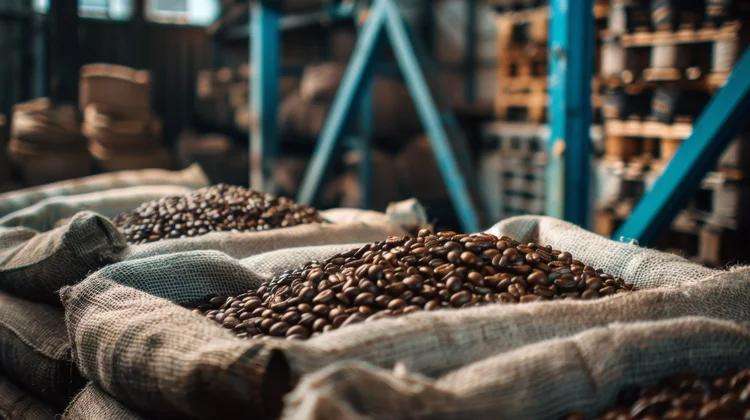
According to recent data released by the Brazilian National Supply Company (Conab), the national coffee production in 2025 is expected to reach 56.5 million bags (each bag weighing 60 kilograms), representing a 4.3% increase compared to 2024.
Reports indicate that despite this year being a "small year" in the Brazilian coffee production cycle, this expected production volume ranks third in Conab's historical data, trailing only behind 2020 and 2018, both of which were "big years" for coffee production. Brazil's coffee production experiences fluctuations in a cycle of "small" and "big" years, where if the production is high in the previous year, it might be lower in the following year.
According to Conab's data, the production of Robusta coffee is expected to reach 20.8 million bags this year, a 42% increase year-on-year, potentially setting a new historical record. However, the production of Arabica coffee is predicted to decrease by 9.7% to 35.76 million bags.
As per the Brazilian Coffee Exporters Council (Cecafé), the total export volume of various types of Brazilian coffee in the first 11 months of 2025 was 36.868 million bags, a 21% decrease compared to the same period in 2024. Despite the decrease in export volume, foreign exchange income has grown by 25.3%, rising from $11.377 billion in the same period last year to $14.253 billion this year.
Despite the decline in export volume partly due to the impact of the new U.S. tariff policy, the United States remains the largest buyer of Brazilian coffee this year, purchasing as high as 5.042 million bags from January to November. Although this figure accounts for 13.7% of Brazil's total coffee exports, it represents a 32.2% decrease compared to the same period in 2024.
Apart from the United States, as of November, the second-largest buyer of Brazilian coffee this year is Germany, with a purchase volume of 5.003 million bags, a 31% decrease compared to the same period last year. Following are Italy, Japan, and Belgium, with purchase volumes of 2.912 million bags, 2.413 million bags, and 2.146 million bags respectively, showing year-on-year decreases of 21.7%, 17.5%, and 47.5%.




China——Brazil Trajectory Tracking


+86 532-85066033/34






 中文简体
中文简体 ENGLISH
