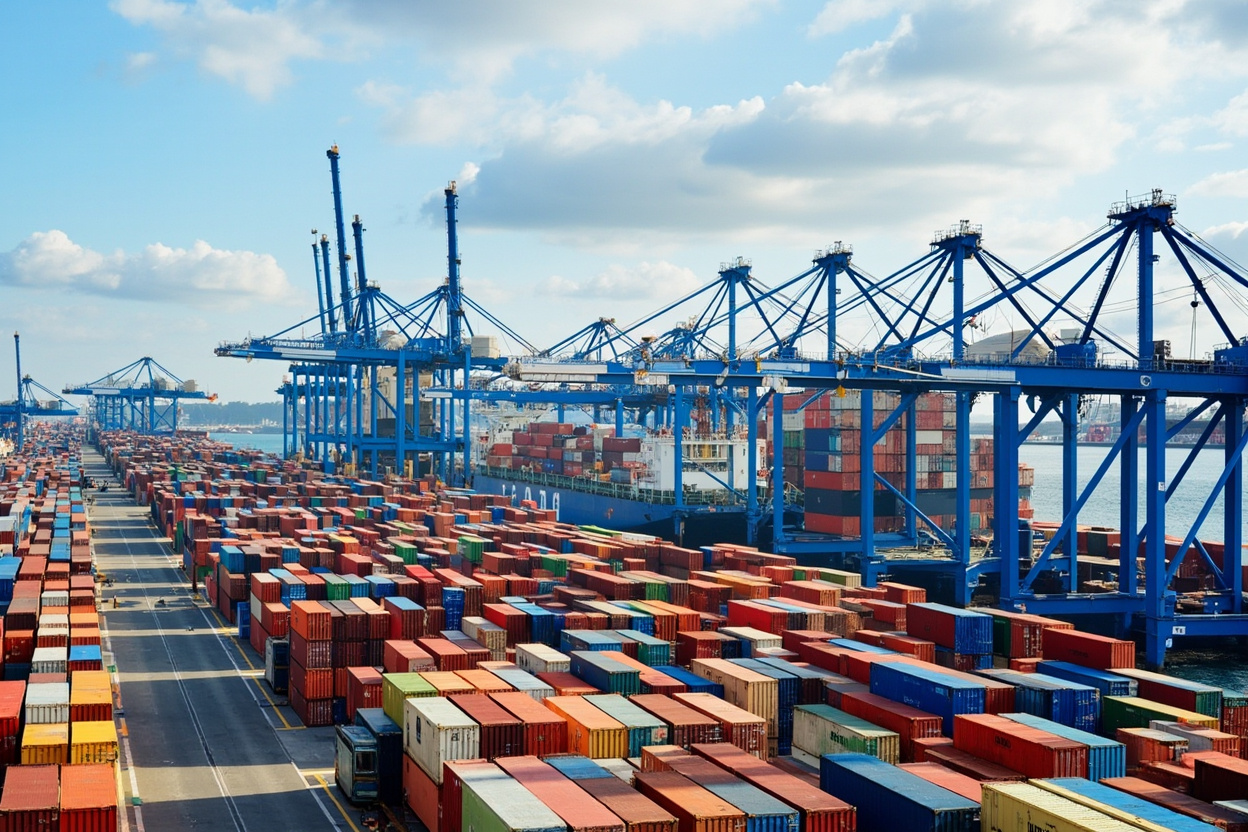
In mid-May 2025, trans-Pacific route freight rates ushered in a new round of dramatic increases. According to Drewry's latest weekly report data, Shanghai to Los Angeles route freight rates rose 10% in a single week, climbing to $3,357 per FEU; the Shanghai to New York route saw an even more astonishing 14% increase, reaching $4,252 per FEU. Simultaneously, Xeneta regional index data shows West US route reference price at approximately $2,884/FEU and East US route at approximately $3,974/FEU.
Notably, this US line freight rate trend has shown clear divergence from Asia-Europe routes. Since May 15, the three major shipping giants—Maersk, CMA CGM, and Hapag-Lloyd—have simultaneously raised Asia-Europe route rates, while trans-Pacific US lines have moved independently, strengthening counter-trend. This phenomenon stems from the multiple overlapping effects of sustained recovery in the US consumer market, strong restocking demand in the supply chain, and structural tightness in capacity.
For freight forwarding companies and foreign trade exporters, sharp freight rate fluctuations directly erode profit margins. How to ensure customers' cargo is smoothly shipped under high freight rate pressure has become the embodiment of freight forwarders' core competitiveness.
The US retail inventory restocking cycle began in the second half of 2024, maintaining strong import demand. Recovering durable goods orders and dense e-commerce promotional activities have provided sustained support for trans-Pacific space bookings. The Shanghai to New York route, which saw the largest freight rate increase, is a direct reflection of the East US consumer market's dependence on Chinese manufacturing.
After years of overcapacity, global container ship capacity showed structural tightness in 2025. On one hand, the scrapping of some old vessels accelerated, with capacity exits exceeding new additions. On the other hand, frequent blank sailings compressed actually available capacity further. As the world's second-largest trade corridor, competition for trans-Pacific space is particularly fierce.
This round of freight rate increases is also closely related to major shipping companies adjusting their pricing strategies. The three major shipping giants' coordinated push to raise Asia-Europe rates simultaneously raised the transpacific pricing benchmark, further amplifying market sentiment. For freight forwarding companies, understanding shipping companies' pricing logic is a prerequisite for grasping market windows.
During upward freight rate cycles, the "wait and see" mentality often costs companies more. Experienced freight forwarders typically advise customers to lock rates in advance—when freight rates are at relatively low levels, sign phased contract rates with shipping companies or first-tier freight forwarders to fix costs and avoid subsequent rate increase risks.
In specific operations, freight forwarding companies can help customers develop batched rate-locking plans based on shipping rhythms: lock 40%-50% of annual total cargo volume in contract form in advance, with the remaining portion flexibly shipped at market rates. This controls the cost ceiling while retaining benefit-sharing space when prices callback.
Single-route dependency carries extremely high risk. Freight forwarding companies should proactively build a multi-channel shipping system for customers:
The core value of multi-channel layout: when the primary channel faces freight rate surges or capacity tightness, customers still have alternative routes to choose from, and shipping plans are not constrained by single factors.
Since freight rates are calculated per FEU (40-foot equivalent unit), optimizing container loading plans is the most direct means of reducing unit logistics costs. Freight forwarding companies should assist customers with the following:
| Optimization Direction | Specific Measures |
|----------------------|-------------------|
| Container utilization | Reasonably match cargo volume and weight to avoid "container underloading" |
| Cargo combination | Merge same-batch goods for shipment to reduce warehouse waiting |
| Loading process | Optimize stacking sequence and filling plans to improve space utilization |
| Light and heavy cargo pairing | Mix lightweight and heavyweight cargo in one container to amortize fixed costs |
Additionally, for high-value goods, customers can be advised to adopt a "LCL to FCL" strategy: combining multiple small shipments into a full container to enjoy FCL freight rates while reducing bill of lading fee expenses.
When sea freight rate increases exceed customers' budget tolerances, freight forwarding companies should promptly provide reference alternatives for sea-air combined transport or pure air freight. Although air freight costs are typically 3-5 times sea freight, for urgent restocking, high-value goods, or high-turnover inventory, air freight's "time premium" may sometimes be the most economical choice.
Freight forwarding companies are advised to embed real-time sea-air freight rate comparison functions in their quotation systems, helping customers make cost-time optimal decisions at the first moment.
Freight forwarding companies should establish freight rate monitoring and early warning systems. When authoritative indices such as Drewry/Xeneta show significant fluctuations, proactively push analysis reports and coping recommendations to customers. Proactive early warnings earn more customer trust than passive responses.
During freight rate fluctuation periods, customers' short-term capital pressure increases. Freight forwarding companies can partner with financial institutions to offer freight installment or advance shipping payment services to creditworthy customers. This both eases customers' capital turnover difficulties and enhances customer粘性 (stickiness/loyalty).
Different industries have significantly varying freight needs. Freight forwarding companies should deepen expertise in 1-2 advantageous industries (such as cross-border e-commerce and manufacturing intermediate goods), providing customized rate-locking and logistics solutions based on their shipping patterns to form differentiated competitive barriers.
Freight rate fluctuations are the new normal in the freight forwarding industry. Excellent freight forwarding companies do not start finding solutions only when freight rates rise—they work with customers to develop contingency plans when rates are low and help customers execute efficiently when rates are high.
For foreign trade exporters, choosing a freight forwarding partner with market insight, channel integration capabilities, and emergency response speed is key to maintaining supply chain resilience in fierce international competition.
For freight forwarding companies, every freight rate fluctuation is a battlefield testing professional capabilities. Accumulating each coping experience into methodology, and delivering each round of market insights to customers, builds long-term reputation in this cyclical industry.
In the medium to long term, trans-Pacific route freight rates will continue to be disturbed by multiple factors: evolution of global trade patterns, rising costs from green shipping transformation, and changes in geopolitical situations. Greater freight rate fluctuation amplitudes and shortened cycles are likely.
Freight forwarding companies can only stand firm in freight rate waves by continuously strengthening data analysis capabilities, deepening channel network layout, and enhancing customer service agility—helping customers navigate cycles and achieve sustainable supply chain operations.
Note: Freight rate data in this article references Drewry's May 16, 2025 weekly report and Xeneta regional indices, for industry reference only. Actual freight rates are based on real-time quotations.




China——Brazil Trajectory Tracking



+86 532-85066033/34






 中文简体
中文简体 ENGLISH
