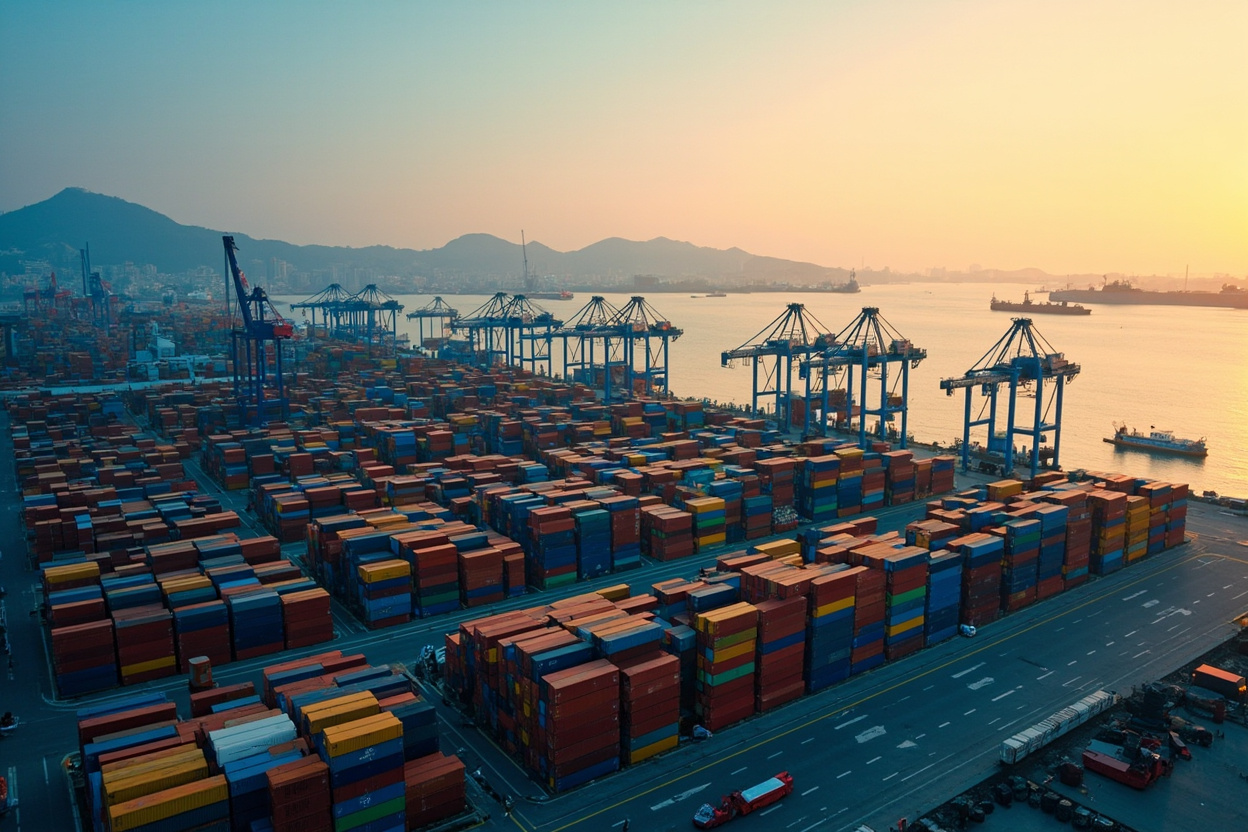
In May 2026, a special action for cross-border trade facilitation was deeply implemented across 45 port cities nationwide, and the General Administration of Customs simultaneously launched 29 major measures across 5 areas. This round of reforms, with GBA (Guangdong-Hong Kong-Macao Greater Bay Area) customs clearance time reduction by half as its core objective, has further reduced overall export customs clearance time by half, marking that regional cross-border trade has entered a new phase. For import-export companies and foreign trade enterprises relying on international logistics, this reform brings not only time improvement but also structural optimization of comprehensive logistics costs.
Shenzhen Customs's pioneering "inspect before loading" supervision model has become the biggest highlight of this reform. The model has been fully implemented across 12 GBA consolidation centers. Goods can complete customs inspection procedures right at the consolidation warehouse; after passing inspection, they are directly loaded and shipped without waiting for vessel schedules or flights.
This innovation has significantly improved the efficiency of freight forwarding services and international logistics. Previously, export goods needed to complete customs declaration first, then wait for inspection, and only then could they be loaded — the entire chain often took more than 48 hours. Now, with front-loaded inspections at consolidation centers, the average shipping time for goods has been compressed to one-third of the original. For time-sensitive goods, freight forwarding companies can more precisely arrange vessel schedules, reducing storage costs caused by waiting.
Sea-air intermodal efficiency has also improved. Consolidation centers in Shenzhen, Guangzhou, and Zhuhai are now linked with Baiyun International Airport and Hong Kong International Airport, enabling cross-border e-commerce goods to transition from road to air transport more quickly, improving overall transit time by approximately 40%. This also gives freight forwarding companies greater flexibility in designing multimodal transport solutions.
The Guangdong-Hong Kong customs "Cross-Border One Lock" cooperation has completed a technical upgrade, achieving millisecond-level bidirectional data comparison for electronic seals. This breakthrough means a qualitative change in the efficiency of land port crossings between Shenzhen and Hong Kong.
At the four major land ports — Huanggang, Shenzhen Bay, Wenjin, and Sha Tau Kok — the average clearance time for single vehicles has been compressed from the original 30+ minutes to under 15 minutes. For the tens of thousands of cargo vehicles crossing daily, this is equivalent to doubling the number of transport trips per day.
For freight forwarding companies and logistics managers, this means the certainty of cross-border road transport timeliness has greatly improved. The risk of delays caused by port congestion has significantly decreased, allowing freight forwarding companies to more precisely estimate transport cycles when quoting and provide more competitive freight rate solutions.
At the same time, millisecond-level data exchange through electronic seals has also reduced the possibility of duplicate inspections. Guangdong and Hong Kong customs systems share cargo information in real time: one vehicle, one lock, one inspection, full control throughout — greatly reducing corporate time costs and compliance costs.
According to data released by the General Administration of Customs, after the reform was implemented, enterprise export customs clearance time decreased by over 50% and comprehensive logistics costs dropped by approximately 30%. Behind this number is the叠加 effect of a series of systemic changes.
First is time cost. Compressed customs clearance time means the停留 time of goods at ports has been greatly shortened. Taking a standard container as an example, the average time from container consolidation to loading previously averaged 72 hours; it has now been compressed to under 24 hours. For high-value-added export commodities, time is cash flow, and reduced time costs directly translate to improved financial costs.
Second is warehousing cost. Shenzhen's "inspect before loading" model means goods no longer need to be moved to designated inspection areas during the inspection process; the entire process can be completed at the consolidation center. This means enterprises can reduce warehousing configuration around ports, shifting inventory strategy from "bulk in, bulk out" to "fast in, fast out."
Third is labor cost. After the Guangdong-Hong Kong "Cross-Border One Lock" became electronic, enterprises no longer need to arrange dedicated personnel to accompany vehicles through customs procedures; clearance formalities can be automatically completed through systems. For freight forwarding companies with cross-border transport operations, this means they can optimize dispatcher staffing and redirect more resources to customer service and route optimization.
Considering the above factors, for a foreign trade company with annual exports of approximately $50 million, the cost savings from compressed customs clearance time can reach millions of yuan per year. This is why more and more import-export companies are beginning to reevaluate their international logistics solutions.
The Hong Kong SAR Government has clearly proposed plans for comprehensive construction of "smart ports" and "green shipping corridors," which complement the mainland's cross-border trade facilitation reforms. It can be foreseen that future competition in the GBA's international logistics will shift from single-point customs clearance efficiency comparisons to full-chain digitalization and green transformation.
For freight forwarding companies, early deployment of digital systems, accumulating multimodal transport experience, and enhancing green logistics service capabilities will become the key to standing out in the next phase of competition. For the majority of import-export companies and logistics managers, choosing freight forwarding service providers with digital capabilities and familiarity with GBA customs new rules will directly impact the efficiency and cost of cross-border trade.
The 50% reduction in GBA customs clearance time is not an endpoint but a starting point. It can be expected that more facilitation measures will continue to be introduced, and the golden era of regional cross-border trade is accelerating.




China——Brazil Trajectory Tracking



+86 532-85066033/34






 中文简体
中文简体 ENGLISH
